
HIGH-PERFORMANCE LONGEVITY FOR PROFESSIONALS
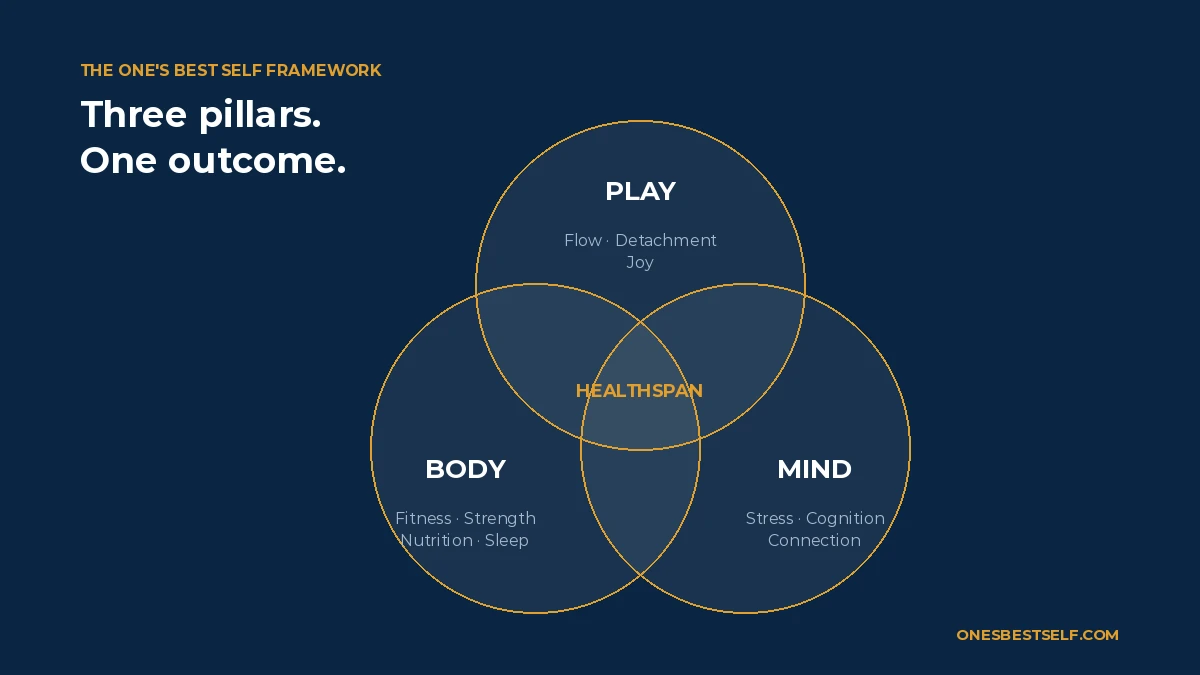
For the high performer, health is the one asset that cannot be outsourced, delegated or bought back later. This guide is the operating framework behind One’s Best Self: an evidence-led approach to extending healthspan, the years you spend in full physical and cognitive capacity, organised around three pillars: Mind, Body and Play.
Executive Brief
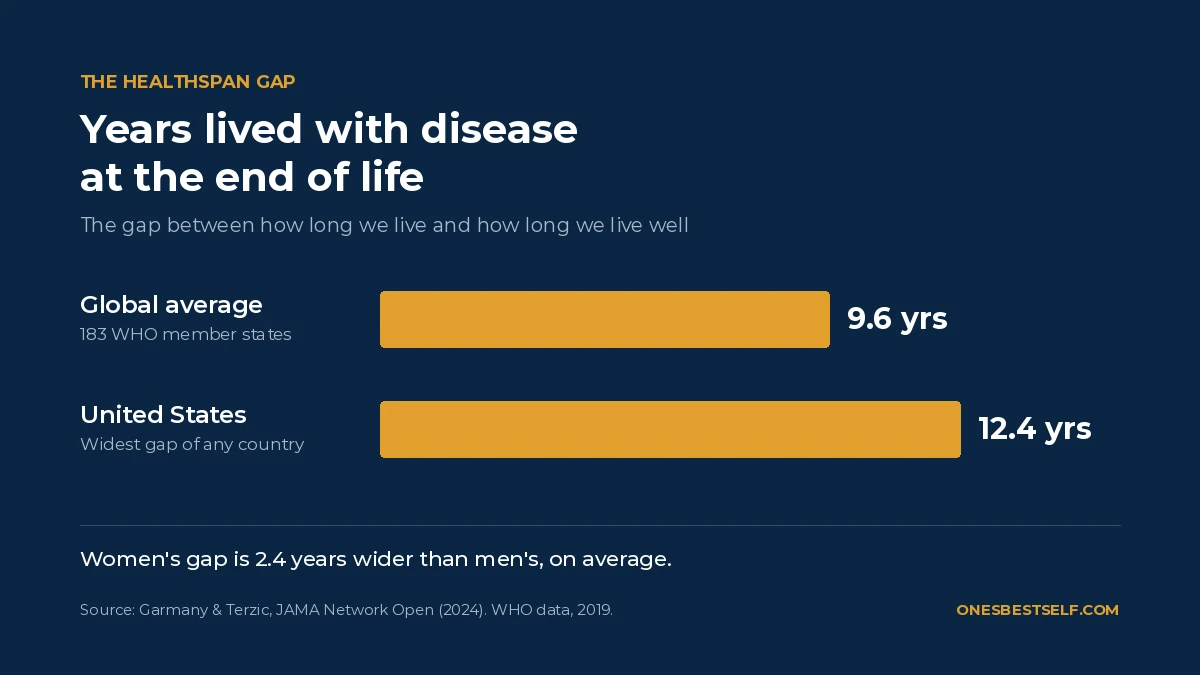
- The gap is real. Globally, people now spend an average of 9.6 years living with disease at the end of life, and the gap is widening.
- Fitness is the highest-return lever. Cardiorespiratory fitness and muscular strength are among the strongest predictors of how long, and how well, you live.
- The brain is modifiable. Up to 45% of dementia cases are linked to risk factors you can influence, from blood pressure to social connection.
Why Healthspan Is the Ultimate Executive KPI
Lifespan measures how long you live. Healthspan measures how long you perform. Modern medicine has become very good at extending the first and far less effective at protecting the second.
A 2024 Mayo Clinic analysis of 183 countries found the global healthspan-lifespan gap has widened to 9.6 years, with women carrying a gap 2.4 years wider than men.[1] In the UK, the latest Office for National Statistics data puts healthy life expectancy at birth for men at just 60.7 years: well short of retirement, let alone life expectancy.[2]
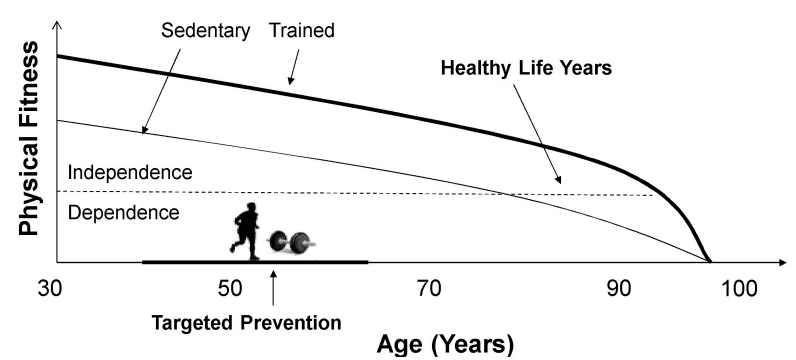
The strategic objective is compression of morbidity: keeping functional capacity high for as long as possible and shortening any period of decline. Think of it as protecting the balance sheet of your most important asset, the one that underwrites every other.
The Biology in Brief: What Actually Drives Ageing
Researchers now describe twelve interconnected “hallmarks of ageing”.[3] Four matter most for day-to-day performance:
Mitochondrial Dysfunction
The power plant. Mitochondria turn food into ATP, the body’s energy currency. As their efficiency drops with age, stamina falls and thinking slows.
Cellular Senescence
The “zombie cell” problem. Damaged cells stop dividing but refuse to die, lingering in tissues and releasing inflammatory signals that harm healthy neighbours.
Inflammageing
The silent fire. Low-grade, systemic inflammation that builds with age and raises the risk of heart disease, diabetes and dementia.
Loss of Proteostasis
Quality control. The body’s system for repairing or recycling damaged proteins. When it falters, misfolded proteins accumulate, a feature of neurodegenerative disease.
The good news: the lifestyle levers below act on several of these processes at once. For a deeper look, see Biological Age: A Strategic Framework.
Pillar One: Body
The physical foundation: the systems that determine your energy, resilience and long-term independence.
Cardiorespiratory Fitness and VO2 Max
VO2 max, the maximum amount of oxygen your body can use, is one of the most powerful predictors of longevity we have. In a study of more than 122,000 adults, those with the lowest fitness had around five times the mortality risk of the fittest, a gap larger than that associated with smoking or diabetes.[4]
- The baseline: 150 to 300 minutes of moderate activity per week, or 75 to 150 minutes of vigorous activity, in line with WHO guidelines.[5]
- Zone 2: steady aerobic work at a pace where you can still hold a conversation. It builds the aerobic base efficiently and fits around a working day. Read or listen: Zone 2 Training, Explained.
- One hard session: a weekly interval session to push the upper limit of your aerobic capacity.
- Daily movement: mortality risk falls as daily steps rise, levelling off at around 8,000 to 10,000 steps for under-60s.[6]
Strength and Structural Capital
Muscle is metabolic infrastructure. It absorbs glucose, protects joints and preserves independence later in life. A 2022 meta-analysis found that just 30 to 60 minutes of muscle-strengthening activity per week was associated with a 10 to 20% lower risk of death from all causes, cardiovascular disease and cancer.[7] Grip strength is a useful proxy: in a study across 17 countries, every 5 kg reduction was linked to a 16% higher risk of death.[8]
- Frequency: two to three sessions per week.
- Focus: compound movements (squat, hinge, push, pull, carry) that recruit the most muscle for the time invested.
Nutrition and Metabolic Health
If your metabolism is dysregulated, every other intervention delivers a diminished return. The strongest evidence supports a Mediterranean-style pattern: in the PREDIMED trial, it reduced major cardiovascular events by around 30% compared with a reduced-fat diet.[9]
- Protein: sufficient at every meal to protect muscle as you age, roughly 1.2 to 1.6 g per kg of body weight for active adults.
- Fibre: 30 g a day, the UK target. Higher fibre intakes are consistently associated with lower mortality and chronic disease.[10]
- Fermented foods: a ten-week Stanford trial found a high-fermented-food diet increased gut microbiome diversity and lowered inflammatory markers.[11]
- Know your numbers: HbA1c, fasting insulin and ApoB give an earlier read on metabolic and cardiovascular risk than standard checks alone.
Sleep Architecture and Recovery
Sleep is not downtime; it is when the brain clears metabolic waste and consolidates memory. Regularly sleeping too little is associated with a 12% higher risk of early death.[12] For an executive, poor sleep is a direct tax on decision quality and emotional regulation.
- Consistency: wake within the same 30-minute window every day, weekends included.
- Environment: cool, dark and quiet, at around 18°C.
- Light: morning daylight, and screens down in the hour before bed.
Pillar Two: Mind
Cognitive capital is what you are paid for. Protecting it is not a soft priority; it is risk management.
The 2024 Lancet Commission identified 14 modifiable risk factors, including physical inactivity, high blood pressure, high LDL cholesterol, hearing loss and social isolation, which together account for an estimated 45% of dementia cases worldwide.[13] Most of them are addressed by the same habits that protect the heart.
Exercise and the Executive Brain
Exercise is the most potent cognitive intervention available. It raises brain-derived neurotrophic factor (BDNF), which supports the growth of new neurons and synapses. In one landmark trial, a year of regular aerobic exercise increased the size of the hippocampus, the brain’s memory centre, by 2% in older adults, effectively reversing one to two years of age-related loss.[14]
Stress Resilience
Acute pressure sharpens performance; chronic stress erodes it. Research on people under long-term psychological stress found cellular ageing markers equivalent to roughly a decade of additional ageing.[15] The aim is not to eliminate pressure but to build reliable recovery into the working day.
- Box breathing: four seconds in, hold, out, hold. A fast way to down-regulate between meetings.
- Non-sleep deep rest: 10 to 20 minutes of guided relaxation to restore focus mid-afternoon.
Cognitive Reserve and Connection
Learning demanding new skills, such as a language or an instrument, builds cognitive reserve: the brain’s capacity to absorb damage without losing function. Relationships matter just as much. A meta-analysis of nearly 150 studies found that people with stronger social relationships had a 50% greater likelihood of survival over the study periods.[16]
Pillar Three: Play
Play is the most neglected pillar among high performers, and the one most often sacrificed first. It shouldn’t be. Engaging in enjoyable leisure activities is associated with lower blood pressure, lower cortisol and better psychological and physical functioning.[17]
Play delivers what recovery alone cannot: genuine detachment from work, flow states that restore attention, and social connection that protects the brain. It is where Body and Mind converge, whether that is a racquet sport, a choir, a climbing wall or a new instrument.
Protecting Play
- Budget it: aim for two to five hours of active, intrinsically rewarding play each week, scheduled and protected like any board meeting.
- Make it active and social where you can, to compound the benefits.
Your Executive Weekly Plan
A template that balances training load with recovery and protects time for play. Adapt it to your diary; consistency matters more than perfection.
| Day | Focus | Action |
|---|---|---|
| Monday | Strength (lower body) | 45 min resistance training + 20 min Zone 2 |
| Tuesday | Aerobic base | 45 min Zone 2 (walk, cycle or row) |
| Wednesday | Strength (upper body) | 45 min resistance training |
| Thursday | Recovery + Mind | 30 min mobility, long walk, 15 min NSDR |
| Friday | High intensity | 20 min intervals + full-body strength |
| Saturday | Play | 60–90 min active, social play (sport, hike, dance) |
| Sunday | Full recovery | No structured training; time with people, meal prep, early night |
Extend Your Performance Runway
Download the Executive Longevity Blueprint: a 90-day protocol to audit your biomarkers, reduce biological debt and extend your performance runway. Evidence-based insight on healthspan, cognition and recovery, delivered to your inbox. Five minutes to read. Zero fluff. Unsubscribe anytime. See our Privacy Policy.
On the Horizon: Emerging Longevity Science
Lifestyle remains the foundation, and the evidence for it is far stronger than for anything below. These areas are worth watching, not yet worth betting on:
- Senolytics: compounds designed to clear senescent cells. Human trials are at an early stage.
- NAD+ precursors: molecules that support cellular energy and repair. Results in humans so far are mixed.
- Epigenetic clocks: tests estimating biological age from DNA methylation. Useful for research, less reliable for individual decisions.
Discuss any of these with a qualified clinician before acting on them.
Frequently Asked Questions
What is the difference between lifespan and healthspan?
Lifespan is the total number of years you live. Healthspan is the number of those years spent in good health, free from chronic disease and with full physical and cognitive function.
What is the single most important habit for healthspan?
Regular exercise that combines aerobic conditioning with strength training. It improves cardiovascular, metabolic and brain health at the same time, and the evidence behind it is stronger than for any supplement or protocol.
How does alcohol affect healthspan?
Alcohol disrupts sleep architecture, adds to systemic inflammation and is one of the Lancet Commission’s dementia risk factors. Less is better; if you do drink, keep it well within the UK guideline of 14 units a week and avoid it in the hours before sleep.
Is it too late to start in my 40s or 50s?
No. Midlife is when many of the most important risk factors take hold, which makes it the highest-return time to act. Strength, fitness and brain health all respond to training at any age.
Should I take supplements?
Treat supplements as the last 5% of the strategy. Get sleep, training and nutrition right first, then target specific gaps based on blood work. See the Executive Supplement Stack.
This guide is for general information and does not replace personalised medical advice. Speak to your GP or a qualified clinician before making significant changes to your exercise, diet or medication.
Evidence & References
We prioritise peer-reviewed studies, clinical trials and official statistics. Last reviewed: October 2026.
- Garmany A, Terzic A. (2024). Global healthspan-lifespan gaps among 183 World Health Organization member states. JAMA Network Open. doi:10.1001/jamanetworkopen.2024.50241
- Office for National Statistics. (2026). Health state life expectancies in the UK: 2022 to 2024. ons.gov.uk
- López-Otín C, et al. (2023). Hallmarks of aging: an expanding universe. Cell. doi:10.1016/j.cell.2022.11.001
- Mandsager K, et al. (2018). Association of cardiorespiratory fitness with long-term mortality among adults undergoing exercise treadmill testing. JAMA Network Open. doi:10.1001/jamanetworkopen.2018.3605
- Bull FC, et al. (2020). World Health Organization 2020 guidelines on physical activity and sedentary behaviour. British Journal of Sports Medicine. doi:10.1136/bjsports-2020-102955
- Paluch AE, et al. (2022). Daily steps and all-cause mortality: a meta-analysis of 15 international cohorts. The Lancet Public Health. doi:10.1016/S2468-2667(21)00302-9
- Momma H, et al. (2022). Muscle-strengthening activities are associated with lower risk and mortality in major non-communicable diseases. British Journal of Sports Medicine. doi:10.1136/bjsports-2021-105061
- Leong DP, et al. (2015). Prognostic value of grip strength: findings from the Prospective Urban Rural Epidemiology (PURE) study. The Lancet. doi:10.1016/S0140-6736(14)62000-6
- Estruch R, et al. (2018). Primary prevention of cardiovascular disease with a Mediterranean diet supplemented with extra-virgin olive oil or nuts. New England Journal of Medicine. doi:10.1056/NEJMoa1800389
- Reynolds A, et al. (2019). Carbohydrate quality and human health: a series of systematic reviews and meta-analyses. The Lancet. doi:10.1016/S0140-6736(18)31809-9
- Wastyk HC, et al. (2021). Gut-microbiota-targeted diets modulate human immune status. Cell. doi:10.1016/j.cell.2021.06.019
- Cappuccio FP, et al. (2010). Sleep duration and all-cause mortality: a systematic review and meta-analysis of prospective studies. Sleep. doi:10.1093/sleep/33.5.585
- Livingston G, et al. (2024). Dementia prevention, intervention, and care: 2024 report of the Lancet standing Commission. The Lancet. doi:10.1016/S0140-6736(24)01296-0
- Erickson KI, et al. (2011). Exercise training increases size of hippocampus and improves memory. PNAS. doi:10.1073/pnas.1015950108
- Epel ES, et al. (2004). Accelerated telomere shortening in response to life stress. PNAS. doi:10.1073/pnas.0407162101
- Holt-Lunstad J, et al. (2010). Social relationships and mortality risk: a meta-analytic review. PLOS Medicine. doi:10.1371/journal.pmed.1000316
- Pressman SD, et al. (2009). Association of enjoyable leisure activities with psychological and physical well-being. Psychosomatic Medicine. doi:10.1097/PSY.0b013e3181ad7978