
Engineering Psychological Armour

Executive Summary
In high-stakes corporate environments, adversity is a constant variable, and how you process it determines your trajectory. We treat resilience not as an innate personality trait or a soft wellness concept but as a cultivated, data-driven system: the deliberate practice of preventing emotional hijacking so your prefrontal cortex keeps command. Engineer your psychological armour and you can navigate intense pressure, recover rapidly from setbacks and lead with clarity when others panic.
The Problem: The Amygdala Hijack
High-achieving professionals often use perfectionism and anxiety as fuel for early-career success. At executive level, that fragile operating system breaks down under complex, compounding stress.
- Emotional hijacking: faced with a severe professional threat, the brain’s fear centre (the amygdala) can override its logical centre (the prefrontal cortex). Rational, data-driven decision-making becomes physiologically impossible.
- The perfectionism trap: a rigid mindset creates psychological fragility. When a strategy fails or a market shifts, leaders without structural resilience suffer prolonged cortisol spikes, leading to defensive decisions, burnout and team instability.
The Strategic Briefing: The Amygdala Hijack
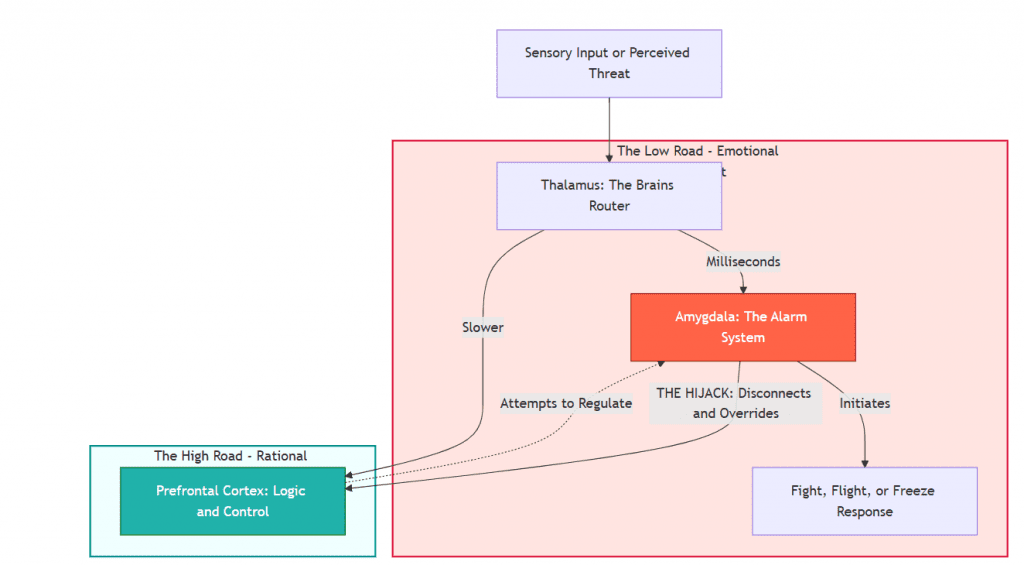
The concept: think of your amygdala as a high-sensitivity alarm. When it detects a professional threat, it severs the connection to your logical brain (the prefrontal cortex).
- Fast (the low road): the amygdala reacts in milliseconds, flooding you with cortisol.
- Slow (the high road): the logical brain takes longer to process, and by then the hijack has already started.
The executive ROI: mastering bottom-up regulation, such as the physiological sigh, lets you re-engage your logical brain on command, so you remain the analytical operator while competitors react on survival instinct.
The Mechanics of the Hijack
1. The router (thalamus). When you experience a stimulus (someone shouts at you, a car swerves into your lane, a stressful email lands), the sensory information goes first to the thalamus, which routes it down two parallel tracks at once.
2. The low road (fast and emotional). One signal goes straight to the amygdala, the brain’s primitive threat-detection centre. This pathway is very fast but sloppy. It ignores nuance and cares only about keeping you alive; if it senses danger, it triggers the release of cortisol and adrenaline.
3. The high road (slow and rational). A second signal goes to the prefrontal cortex (PFC), the logical part of the brain behind your forehead. This takes slightly longer. Normally, the PFC analyses the situation, realises the “threat” is just an annoying email and tells the amygdala to stand down.
4. The hijack. An amygdala hijack happens when the trigger is so strong that the amygdala goes into overdrive before the PFC can assess the situation. It effectively severs the connection to the PFC, flooding the brain with stress hormones and shutting down your ability to think logically, empathise or control impulses. You react purely on survival instinct.
The Solution: The Resilience Protocol
Resilience is a skill trained through deliberate exposure and cognitive reframing. You cannot wait for a crisis to build your armour; you must engineer it in advance. The protocol relies on three psychological interventions.
1. Cognitive Reappraisal (Data Over Emotion)
In a crisis, your biology wants to react to the feeling of the threat. Elite executives train themselves to react only to the data.
- The protocol: when triggered, insert a mandatory tactical pause. Separate the objective facts from the narrative your brain is spinning. Forcing the brain to analyse raw data re-engages the prefrontal cortex and shuts down the panic response.
2. Stress Inoculation (Controlled Adversity)
You build psychological resilience the same way you build physical strength: through progressive overload.
- The protocol: deliberately expose yourself to micro-doses of psychological or physical discomfort outside the boardroom: intense physical conditioning, public speaking or a complex new skill. Repeatedly train your brain to recognise that discomfort does not equal danger.
3. Emotional Granularity
You cannot regulate a system you cannot measure accurately. Most executives have a limited emotional vocabulary (“I’m stressed”, “I’m angry”).
- The protocol: develop high emotional granularity, the ability to identify your internal state precisely (“I am experiencing anticipatory anxiety about this quarterly review”). Labelling the specific emotion decreases amygdala activation and returns control to your logical brain.
The Biological ROI
Systematically upgrading your psychological operating system protects both your career and your healthspan:
- Crisis leadership: while untrained peers succumb to decision fatigue and emotional reactivity, engineered resilience keeps you the calmest, most analytical person in the room.
- Rapid recovery: a resilient nervous system does not avoid stress; it recovers faster. Shorter periods of cortisol elevation after a setback protect your physical health and sleep.
- Sustainable ambition: replacing anxiety-driven perfectionism with structural resilience lets you sustain a high-trajectory career for decades without hitting the wall of burnout.
How to Stop an Amygdala Hijack in Real Time
During a hijack, your brain is flooded with adrenaline and cortisol. Because the connection to your prefrontal cortex is temporarily suppressed, you cannot simply think your way out. You need bottom-up regulation: using your physiology to send a safety signal up the vagus nerve, which brings the PFC back online. Four evidence-based strategies for a hard reset:
1. The Physiological Sigh
This is the fastest hard-wired way to lower autonomic arousal in real time, popularised by neurobiologist Dr Andrew Huberman. Under stress, tiny air sacs in the lungs (alveoli) collapse, leading to a build-up of carbon dioxide that the amygdala reads as a suffocation threat.
- The technique: breathe in deeply through your nose. At the top of the breath, take a second, sharp sip of air to fully expand the lungs. Then exhale slowly and fully through your mouth, making the exhale longer than the inhale.
- The science: the double inhale offloads carbon dioxide, while the long exhale stimulates the vagus nerve to slow your heart rate rapidly.
2. Box Breathing (Tactical Breathing)
Used by Navy SEALs before high-stakes operations, this technique makes your PFC concentrate on counting, pulling metabolic energy away from the amygdala.
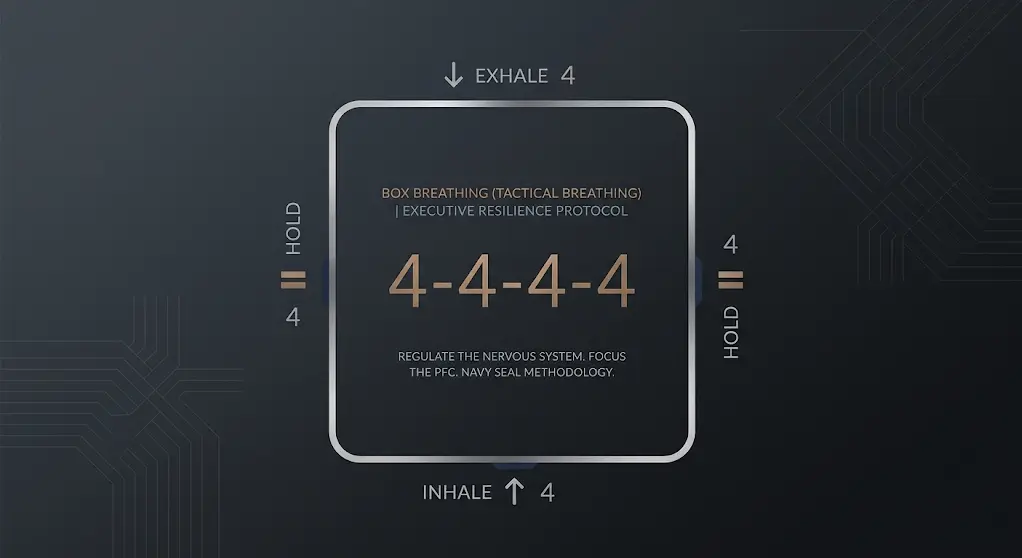
- The technique: inhale for four seconds, hold for four, exhale for four and hold empty for four. Repeat for a few cycles.
- The science: symmetrical breathing balances the sympathetic (accelerator) and parasympathetic (brake) branches of the nervous system, halting the escalation of panic.
3. The Mammalian Dive Reflex (Cold Exposure)
In a severe hijack, such as an impending panic attack, when breathing techniques feel impossible, use temperature to force a biological override.
- The technique: splash very cold water onto your face and eyes, or hold a piece of ice in your hand.
- The science: sudden cold on the facial nerves activates the mammalian dive reflex, an ancient mechanism for conserving oxygen underwater. It drops your heart rate and directs blood flow back towards your core and brain, snapping you out of the emotional loop.
4. Affect Labelling (Name It to Tame It)
Once your physiology has calmed slightly, lock the prefrontal cortex back into the driving seat.
- The technique: put a concrete label on what you are experiencing, out loud or clearly in your head: “I am feeling a surge of anger right now” or “My chest is tight and I am experiencing acute stress.”
- The science: fMRI studies, notably by Dr Matthew Lieberman at UCLA, show that searching for a word to describe an emotion activates the right ventrolateral prefrontal cortex (RVLPFC), the brain’s braking system. Naming the emotion turns on the PFC, which dials down amygdala activity.
The Yerkes-Dodson Law

The Yerkes-Dodson law is a fundamental concept in psychology describing the relationship between stress (arousal) and cognitive performance. You need a certain amount of stress to perform at your best, but too much makes performance crash. The curve works across three zones.
1. The Left Side: Low Arousal (Under-Engaged)
- The state: boredom, apathy or lack of motivation.
- What is happening: your brain isn’t receiving enough stimulation or pressure to care. With no urgency, focus scatters and energy is low.
- Performance: very low. This is where procrastination lives, and careless mistakes happen through inattention.
2. The Peak: Optimal Arousal (the Zone, or Eustress)
- The state: engaged, focused and energised.
- What is happening: the top of the inverted U. There is enough pressure (a deadline, a challenging task, healthy competition) to release focus-enhancing dopamine and noradrenaline, but not enough to feel threatening.
- Performance: peak. You experience flow, sharp recall and high cognitive flexibility. This positive, motivating stress is known as eustress.
3. The Right Side: High Arousal (Over-Engaged)
- The state: anxiety, overwhelm or panic.
- What is happening: as pressure mounts beyond your optimum, stress becomes distress. The amygdala starts to override the prefrontal cortex.
- Performance: rapidly declining: tunnel vision, impaired decisions, memory blanks (freezing during a speech) and acute fatigue.
The Caveat: Task Complexity Matters
- Simple tasks: for repetitive or physically demanding tasks (a sprint, basic data entry), the curve is wide. You can handle high arousal before performance drops.
- Complex tasks: for cognitively demanding work (writing code, playing chess, defusing a tense negotiation), the curve is narrow. Even moderate anxiety disrupts executive function, so you need a calmer state to hit your peak.
Evidence & Citations
This article is based on scientific evidence and fact-checked by our editorial team. We prioritise peer-reviewed studies, clinical trials and academic consensus.
- McEwen, B. S. (2017). Neurobiological and systemic effects of chronic stress. Chronic Stress (Thousand Oaks). View study
- Kim, H. G., et al. (2018). Stress and heart rate variability: a meta-analysis and review of the literature. Psychiatry Investigation. View study
- Southwick, S. M. & Charney, D. S. (2012). The science of resilience: implications for the prevention and treatment of depression. Science. View study
- Goleman, D. (1995). Emotional Intelligence: Why It Can Matter More Than IQ. Bantam Books.
- LeDoux, J. E. (2000). Emotion circuits in the brain. Annual Review of Neuroscience, 23(1), 155–184. View study
- Yerkes, R. M. & Dodson, J. D. (1908). The relation of strength of stimulus to rapidity of habit-formation. Journal of Comparative Neurology and Psychology, 18(5), 459–482. View study
Back to the Mind pillar or explore the full Executive’s Guide to Healthspan.
Extend Your Performance Runway
Download the Executive Longevity Blueprint: a 90-day protocol to audit your biomarkers, reduce biological debt and extend your performance runway. Evidence-based insight on healthspan, cognition and recovery, delivered to your inbox. Five minutes to read. Zero fluff. Unsubscribe anytime. See our Privacy Policy.