
Controlling the Autonomic Nervous System

Executive Summary
In high-stakes corporate environments, stress is not an emotion; it is a measurable physiological state. The human body is not designed to sustain chronic, low-grade panic. Operating in continuous fight-or-flight mode degrades the brain’s memory centres, impairs executive decision-making and accelerates systemic ageing. We treat stress management not as a luxury but as a biological mandate. By learning to control your autonomic nervous system, you can down-regulate cortisol on command and prevent executive burnout.
The Problem: Chronic Sympathetic Overdrive
Your biology cannot distinguish between a physical threat and a high-stakes board meeting or a missed quarterly target. Under pressure, the brain activates the HPA (hypothalamic-pituitary-adrenal) axis, releasing cortisol and adrenaline into your bloodstream. That is useful for acute survival, but chronic activation is deeply destructive:
- Structural brain damage: prolonged exposure to high cortisol shrinks the hippocampus (the brain’s centre for memory and learning) while enlarging the amygdala (the fear and anxiety centre).
- The “tired but wired” loop: chronic stress disrupts the natural cortisol curve. Instead of peaking in the morning and dropping at night, cortisol stays elevated into the evening, disrupting sleep architecture and leaving you exhausted on waking.
The Solution: The Autonomic Control Protocol
You cannot eliminate stress from an executive career, but you can control how quickly your biology recovers from it. The goal is a flexible nervous system that can spike for a major presentation and return immediately to a calm baseline. For a step-by-step daily routine, see our guide to how to reduce cortisol naturally.
1. Physiological Down-Regulation (Vagal Tone)
You can override the stress response by stimulating the vagus nerve, the primary control centre for the parasympathetic (rest and digest) nervous system.
- The protocol: when acute stress hits, use the physiological sigh: two sharp inhales through the nose followed by one long, extended exhale through the mouth. Repeat three to five times. The extended exhale slows your heart rate and rapidly halts the release of adrenaline.
2. Engineered Hormetic Stress
To make your nervous system more resilient to unpredictable corporate stress, expose it to controlled, predictable stress. This is called hormesis.
- The protocol: use deliberate cold exposure (a two-minute cold shower or an ice bath) or intense sauna sessions. These force your vascular system to react and recover, training your brain to stay calm while the body is under physiological duress.
3. Cognitive Compartmentalisation
Ruminating on work problems at 9pm signals to your body that the threat is still present.
- The protocol: establish a physical or psychological shutdown routine at the end of the working day. Write down tomorrow’s critical tasks, close the laptop and leave the workspace. This boundary signals to the HPA axis that it is safe to down-regulate.
The Biological ROI
When you stop treating stress as an inevitable emotional burden and start treating it as a physiological lever, your output transforms:
- Protected cognitive architecture: keeping cortisol in check defends your memory centres from degradation, so you stay sharp well into later life.
- Elite decision-making: when the amygdala is calm, the prefrontal cortex operates at full capacity. You make logical, data-driven decisions while peers react emotionally.
- Eradication of burnout: burnout is the biological failure of an overtaxed nervous system. Master your recovery curve and you can sustain high-level output.
Overview of the HPA Axis
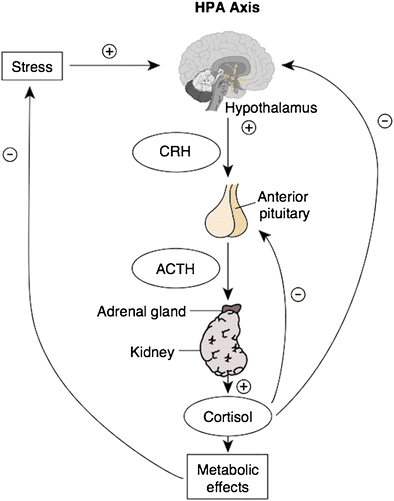
The Strategic Briefing: The HPA Axis
The concept: think of the HPA axis as your body’s biological alarm system. It coordinates the cascade from a stressful thought in your brain to the physical release of energy (cortisol) in your blood.
- The trigger: your brain perceives a threat, whether a deadline or a danger.
- The signal: a chain reaction moves from the hypothalamus to the pituitary gland and finally to the adrenal glands.
- The output: your body floods with cortisol to provide immediate energy and focus.
The executive risk: in a healthy system, the brakes (the negative feedback loop) engage once the threat passes. Under chronic corporate stress, the brakes fail. Cortisol stays high, leading to “tired but wired” exhaustion, memory degradation and systemic burnout.
How the Mechanism Works
1. The commander (hypothalamus). When your brain, specifically the amygdala, perceives a threat (a car swerving towards you or a looming deadline), it alerts the hypothalamus. The hypothalamus acts as command centre and releases CRH (corticotropin-releasing hormone).
2. The dispatcher (pituitary gland). CRH travels a short distance to the pituitary gland, a pea-sized structure at the base of the brain, which secretes ACTH (adrenocorticotropic hormone) into the bloodstream.
3. The responders (adrenal glands). ACTH travels through the blood to the adrenal glands on top of the kidneys, which pump out cortisol along with adrenaline.
- What cortisol does: it mobilises the body’s resources for immediate survival. It floods the bloodstream with glucose for fast energy, alters immune responses and suppresses the digestive and reproductive systems (you don’t need to digest lunch if you are running for your life).
4. The brakes (the negative feedback loop). A healthy HPA axis has a built-in shut-off valve. Once blood cortisol is high enough, it binds to receptors on the hypothalamus and pituitary gland, signalling: message received, threat handled, stop sending CRH and ACTH.
When the System Breaks (Chronic Stress)
The HPA axis evolved for acute, short-term stress, such as running from a predator. It is designed to spike and then switch off quickly via the negative feedback loop.
In modern life, stressors are often chronic: constant financial worry, toxic work environments, sleep deprivation. When the HPA axis is constantly activated, the brain’s receptors become desensitised to cortisol. The brakes stop working, leading to persistently high cortisol, chronic inflammation, memory impairment and severe metabolic exhaustion.
Evidence & Citations
This article is based on scientific evidence and fact-checked by our editorial team. We prioritise peer-reviewed studies, clinical trials and academic consensus.
- Sapolsky, R. M. (2004). Why Zebras Don’t Get Ulcers: The Acclaimed Guide to Stress, Stress-Related Diseases, and Coping. Henry Holt and Company.
- McEwen, B. S. (1998). Protective and damaging effects of stress mediators. New England Journal of Medicine. View study
- Chrousos, G. P. (2009). Stress and disorders of the stress system. Nature Reviews Endocrinology. View study
- Smith, S. M. & Vale, W. W. (2006). The role of the hypothalamic-pituitary-adrenal axis in neuroendocrine responses to stress. Dialogues in Clinical Neuroscience, 8(4), 383–395. View study
Back to the Mind pillar or explore the full Executive’s Guide to Healthspan.
Extend Your Performance Runway
Download the Executive Longevity Blueprint: a 90-day protocol to audit your biomarkers, reduce biological debt and extend your performance runway. Evidence-based insight on healthspan, cognition and recovery, delivered to your inbox. Five minutes to read. Zero fluff. Unsubscribe anytime. See our Privacy Policy.