VO2 Max: The Executive’s Definitive Guide to Cardiorespiratory Power

A high-performance executive in his late 40s running on a coastal road at sunrise, wearing premium athletic apparel in navy and slate. A glowing digital smart watch on his wrist displays a VO2 Max heart rate interface. Overlaying the scene are subtle, sophisticated gold data holograms and geometric connectivity lines, symbolizing the intersection of biological longevity and data-driven performance. The aesthetic is cinematic, minimalist, and elite, reflecting the One’s Best Self brand.

Executive Summary

  • The purpose of this guide is to provide a high-leverage framework for increasing VO2 Max—the single most accurate predictor of both all-cause mortality and functional healthspan. For the high-performing executive, VO2 Max is not merely a fitness metric; it is a measure of your “aerobic ceiling” and your brain’s ability to remain oxygenated under high-pressure cognitive loads.

    Data from the Mayo Clinic Proceedings indicates that an elite VO2 Max can extend life expectancy by up to five years compared to those with “average” levels. This guide outlines the physiological requirements for increasing this metric, the specific training zones required, and a pragmatic weekly schedule that balances intense output with professional demands.

    Key deliverables in this guide include:

    • The Science of Aerobic Capacity: Understanding the stroke volume and mitochondrial density connection.

    • Zone 2 vs. Zone 5: Clarifying the roles of base-building and peak-performance training.

    • A 12-Week Executive Protocol: A structured plan to move your “biological clock” backward through cardiovascular conditioning.

Introduction: Why VO2 Max is the Ultimate Longevity KPI

Thank you for prioritizing your cardiovascular resilience. In the world of longevity science, there is a clear hierarchy of interventions. While nutrition and sleep are foundational, VO2 Max stands alone as the most potent indicator of how long—and how well—you will live.

What is VO2 Max?

VO2 Max is the maximum amount (Volume) of oxygen (O2) your body can utilize during intense exercise. It is measured in milliliters of oxygen per kilogram of body weight per minute (ml/kg/min).

The Performance Edge

A high VO2 Max means your heart can pump more blood with every beat, and your muscles are more efficient at extracting oxygen. For an executive, this translates to:

  • Increased mental stamina during 10-hour workdays.

  • Faster recovery from travel and jet lag.

  • Significant reduction in the risk of cardiovascular disease and neurodegeneration.

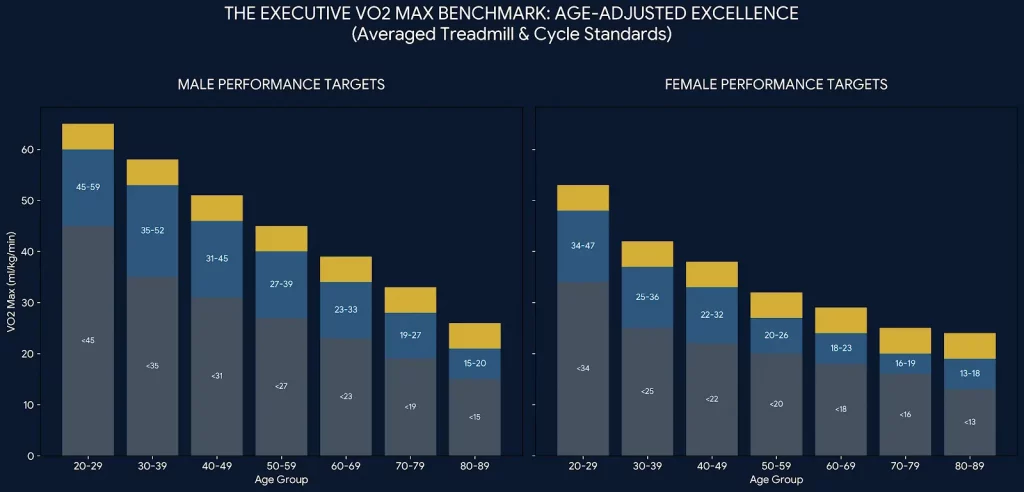
A sophisticated data visualization titled "The Executive VO2 Max Benchmark: Age-Adjusted Excellence." The chart consists of two panels: Male Performance Targets and Female Performance Targets. The X-axis represents age groups from 20-29 through 80-89. Each age group features a stacked bar: a light-grey base for "Low/Average" fitness, a steel-blue middle section for "High" fitness, and a gold-capped top for the "Elite Target." Numeric values denote the exact VO2 Max thresholds, showing the natural biological decline and the high-performance targets required to stay in the 90th percentile.
The Biological KPI: This chart illustrates the "Gold Standard" for cardiorespiratory fitness based on averaged clinical data from both treadmill and cycle testing. To maintain an "Elite" status (the top 10% of your biological peers), your target VO2 Max is highlighted in gold. As an executive, your goal is to "outrun your age"—maintaining a VO2 Max that places you in the elite category of a demographic 10–20 years younger than yourself.

The Science of Aerobic Power: The Fick Equation

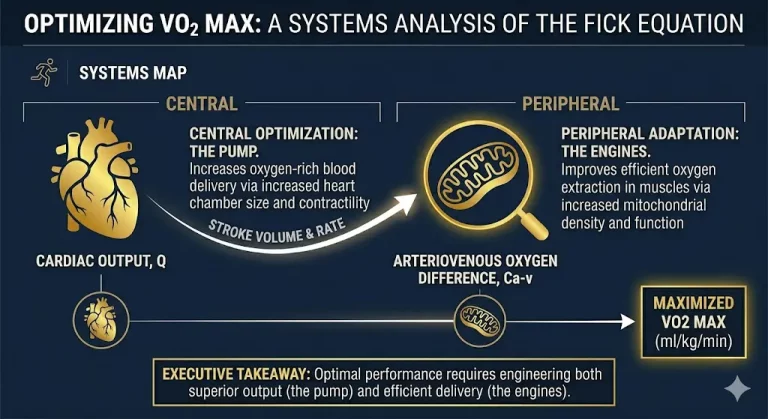
To improve your VO2 Max, we must address the two components of the Fick Equation:

VO2 = Q × (Ca – Cv)

  • Central Adaptation (Q): This is your Cardiac Output. By training, we increase the “stroke volume”—the amount of blood the heart’s left ventricle can push out in a single contraction.

  • Peripheral Adaptation (Ca – Cv): This is the Arteriovenous Oxygen Difference. It represents how efficiently your muscles and mitochondria extract that oxygen from the blood.

To maximize your score, we must train both the “pump” (the heart) and the “engines” (the mitochondria).

A clean, minimalist infographic flowchart titled "A Systems Analysis of the Fick Equation" set against a dark navy background. The visual represents the scientific formula using premium gold icons. A highly-detailed gold heart (The Pump) is connected by thin white lines to a magnified view of a gold mitochondrion (The Engine). Labels highlight 'CENTRAL OPTIMIZATION: DELIVERY' (Stroke Volume) next to the heart, and 'PERIPHERAL ADAPTATION: EXTRACTION' (Mitochondrial Density) next to the mitochondrion. These systems converge on the far right into a glowing gold text box: 'MAXIMIZED VO2 MAX (ml/kg/min)'.
Optimization requires addressing both the pump (heart) and the engine (mitochondria).

Pillar 1: Building the Aerobic Base (Zone 2)

You cannot build a high peak on a narrow base. Zone 2 training is the foundation of VO2 Max. This is steady-state exercise at an intensity where you can still hold a conversation but would prefer not to.

The Strategy:

  • Intensity: 60–70% of your maximum heart rate.

  • Biochemical Benefit: Zone 2 specifically targets Type I muscle fibers, increasing mitochondrial density and improving “metabolic flexibility” (the ability to burn fat for fuel).

  • Executive Integration: This is “low-cost” training. It can often be done while catching up on podcasts, reading briefings on a stationary bike, or during low-stakes walking meetings.

Pillar 2: Raising the Ceiling (Zone 5 / HIIT)

While Zone 2 builds the base, Zone 5 training is what actually “pushes” the VO2 Max needle upward. This involves short bursts of near-maximal effort.

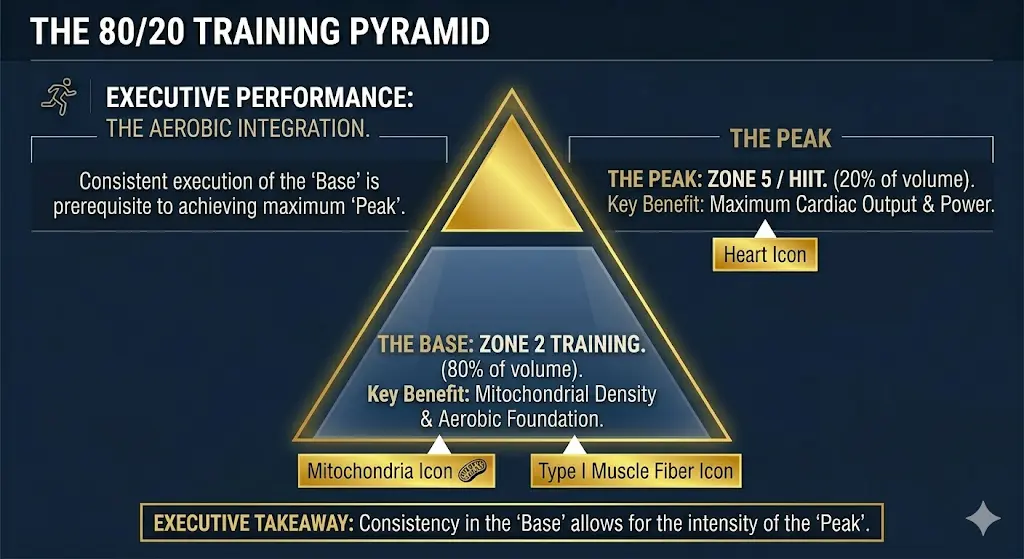
A premium, minimalist infographic titled "THE 80/20 TRAINING PYRAMID" set against a sophisticated dark navy background. It features a large, hollow triangle outlined in shimmering Gold. The pyramid is cleanly divided into two horizontal sections reflecting the 80/20 principle. The large, bottom 80% (Zone 2) is filled with a soft, semi-transparent Navy wash and labeled "THE BASE: ZONE 2 TRAINING (80% of volume)." It shows the key benefit "Mitochondrial Density & Aerobic Foundation." The small, top 20% (Zone 5) is a solid, shimmering Gold block labeled "THE PEAK: ZONE 5 / HIIT (20% of volume)." It shows the key benefit "Maximum Cardiac Output & Power." Small Gold icons of a heart (Stroke Volume) and mitochondria (Extraction) are subtly integrated into the labels. The overall design is modern, engineering-inspired, and data-focused.
Structure Your Intensity: This visual reinforces a critical rule in VO2 Max development: consistent execution of the "Base" (Zone 2) is a prerequisite for achieving a high "Peak" (Zone 5). For executives who prioritize efficiency, this visual corrects the misconception that "maximum effort is maximum improvement." The most effective protocol balances high-volume, low-intensity training to build mitochondrial density (peripheral engines) with short, high-intensity intervals to maximize cardiac stroke volume (central pump). Consistency in the Base allows for true intensity during the Peak.

The Protocol: The Norwegian 4×4

Research from the Norwegian University of Science and Technology has identified this as the “Gold Standard” for VO2 Max improvement:

  1. 4 minutes of high intensity (85–95% of Max Heart Rate).

  2. 3 minutes of active recovery (light walking/pedaling).

  3. Repeat 4 times.


Pillar 3: Monitoring and Testing

In business, we value accurate data. There are two primary ways to track your VO2 Max progress:

  1. The Gold Standard: Metabolic Cart Test

    This involves wearing a mask during a treadmill or bike ramp test to measure actual gas exchange. I recommend executives do this once a year at a specialized longevity or sports medicine clinic.

  2. The Proxy: Wearable Estimation

    Devices like Garmin, Apple Watch, or Oura provide estimated VO2 Max scores. While not as accurate as a lab test, they are excellent for tracking trends.

  3. The Cooper Test (Self-Assessment)

    A simple 12-minute run. The distance you cover can be used to calculate a highly accurate estimate of your VO2 Max.


Practical Protocols: The 12-Week Executive VO2 Max Plan

This plan is designed for a busy professional who can dedicate 3–4 hours per week to cardiovascular health.

PhaseGoalWeekly Commitment
Weeks 1–4Base Building3x 45 min Zone 2 Sessions
Weeks 5–8Introducing Intensity2x 45 min Zone 2 + 1x 4×4 Interval Session
Weeks 9–12Peak Performance1x 60 min Zone 2 + 2x 4×4 Interval Sessions

Strategic Habit: If you have back-to-back meetings, try to schedule at least one “Active Recovery” block where you walk at a Zone 1 or Zone 2 pace. This prevents the “sedentary physiology” that blunts training adaptations.

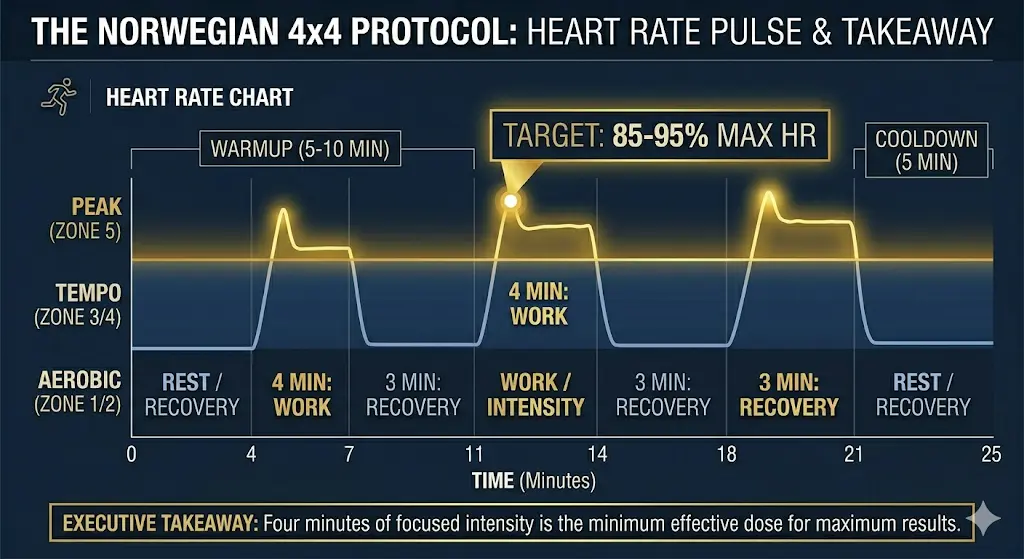
A clean, horizontal line graph titled "The Norwegian 4x4 Protocol: Heart Rate Pulse." The chart is set against a dark navy background. A steady navy line at the bottom represents the 3-minute "Active Recovery" periods. Every 3 minutes, the line spikes into a sharp, glowing gold peak representing the 4-minute "Work" intervals. A prominent call-out box in gold serif font points to the peaks with the text "TARGET: 85–95% MAX HR." The x-axis shows a total duration of approximately 30 minutes, including a 5-minute warm-up and cool-down.
The Gold Standard for Peak Power: The Norwegian 4x4 protocol is designed to maximize cardiac output by forcing the heart to work at its upper limit for a sustained period. This "sawtooth" profile ensures you spend enough time in the high-intensity zone to trigger structural changes in the heart (increasing stroke volume) while providing just enough recovery to maintain that intensity across four separate bouts. Four minutes of focused intensity is the minimum effective dose for maximum results.

Pillar 4: Nutritional and Supplemental Support

  • Iron and Ferritin: Vital for oxygen transport. Executives on plant-based diets should monitor these levels closely.

  • Nitric Oxide Boosters: Foods high in nitrates (beets, arugula) or supplements like L-Citrulline improve blood flow.

  • CoQ10 (Ubiquinol): A critical enzyme for mitochondrial energy production.

  • Hydration + Electrolytes: Blood volume is a key component of stroke volume. Dehydration leads to “cardiac drift,” making the heart work harder for the same output.

Frequently Asked Questions (FAQ)

Can I improve my VO2 Max if I haven’t exercised in years?

Yes. Those with the lowest initial fitness levels often see the most dramatic percentage increases within the first six months.

Is running the only way to train?

No. Rowing, cycling, swimming, and “rucking” (walking with a weighted pack) are all excellent. The modality is secondary to reaching the required heart rate zones.

Should I train on an empty stomach?

For Zone 2, fasted training can improve fat oxidation. For Zone 5 (HIIT), carbohydrates are recommended to ensure you can reach the necessary high intensities.


Final Thoughts

In the high-stakes environment of executive leadership, your aerobic capacity is the “battery” that powers your cognitive and physical output. Increasing your VO2 Max is a direct investment in your future autonomy and resilience.

🔬

Evidence & Citations

This article is based on scientific evidence and fact-checked by our editorial team. We prioritize peer-reviewed studies, clinical trials, and academic consensus.

  1. Mandsager, K., et al. (2018). “Association of Cardiorespiratory Fitness with Long-term Mortality Among Adults Undergoing Exercise Treadmill Testing.” JAMA Network Open.

  2. Helgerud, J., et al. (2007). “Aerobic High-Intensity Intervals Improve $\text{VO}_2\text{max}$ More Than Moderate Training.” Medicine & Science in Sports & Exercise.

  3. Strasser, B., & Burtscher, M. (2018). “Survival of the fittest: $\text{VO}_2\text{max}$, a key predictor of longevity?” Frontiers in Bioscience.

  4. Kaminsky, L. A., et al. (2017). “The Importance of Cardiorespiratory Fitness in the 21st Century.” Progress in Cardiovascular Diseases.

  5. Joyner, M. J., & Lundby, C. (2018). “Concepts about $\text{VO}_2\text{max}$ and Trainability.” Comprehensive Physiology.