
Executive Summary
High‑pressure professionals often plan everything except fun, even though regular, engaging play is a powerful driver of mood, resilience and cognitive health. A “play budget” makes enjoyment intentional: aim for 2–5 hours of active, intrinsically rewarding play each week, scheduled and protected like any other priority. By auditing your current habits, setting a realistic target and tracking how play affects your stress and energy, you can build a sustainable rhythm of activities that make life feel fuller, lighter and more your own.
High‑pressure professionals often budget time for work, exercise and family, but leave play to chance. A “play budget” makes fun as intentional as your financial planning: you decide in advance how much high‑quality, restorative play you want in your week, and where it will fit.
What counts as “high‑quality play”?
For this piece, “play” means active, engaging and intrinsically enjoyable activities you choose for their own sake, not for productivity or self‑improvement. (For the science behind why this matters, see our guide to deliberate play and resilience.)
High‑quality play typically has these features:
- You are doing, not just consuming (creating, moving, interacting, exploring).
- You feel some mix of curiosity, challenge or creativity: the conditions that make flow states possible.
- The goal is enjoyment and engagement, not achievement or optimisation.
- When you finish, you usually feel more refreshed, connected or alive.
Examples: playing an instrument, group sports, board games with friends, dancing, painting, improv, building or tinkering, and playful time with children where you are genuinely involved, not just supervising.
What usually does not qualify: mindless scrolling, background TV, idle snacking, “doom‑scrolling” the news, or drinking purely to unwind. These can be comforting in the moment but rarely deliver the deeper recovery and psychological benefits that real play provides.
How much play per week makes a difference?
We do not have a single, precise number that applies to everyone, but several strands of research on leisure, physical activity and mental health give us useful guardrails. Together, they suggest that even modest, regular doses of active, enjoyable leisure are linked with better mood, lower depression risk and healthier cognitive ageing, especially in mid and later life.
A pragmatic play budget for busy adults in midlife could look like this:
Strategic Briefing: Your Weekly Play Dose
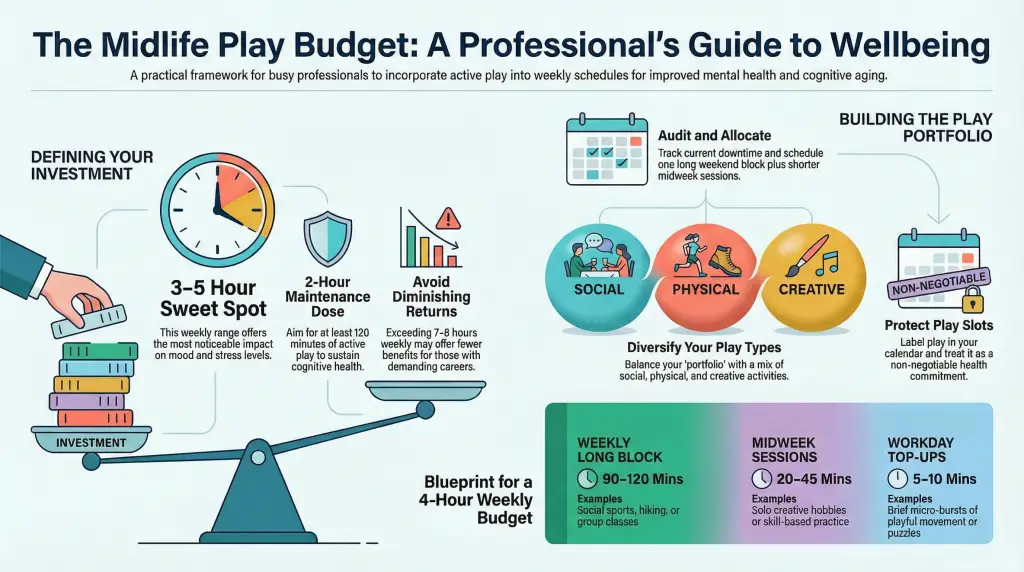
- Minimum dose (maintenance): around 2 hours per week of truly engaging, active play.
- Good target (noticeable impact): 3–5 hours per week, ideally spread across several sessions.
- Upper bound (for most professionals): beyond roughly 7–8 hours weekly, you may see diminishing returns unless your schedule is highly flexible.
These are not rigid prescriptions; they are evidence‑informed ranges you can experiment with. The aim is not perfection, but to move from “almost no play” towards a sustainable level that noticeably improves your wellbeing.
Step 1: Audit your current play
Before you set a budget, you need a clear picture of where you are. Over one typical week, track:
- What you do outside work and essential chores.
- How long you spend on each activity.
- How you feel afterwards: more energised, flat or drained?
At the end of the week, highlight anything that actively engaged you (mind or body), felt enjoyable in the moment, and left you feeling better afterwards. Add up the time from those activities: this is your current play budget.
You may discover that:
- You have more play than you thought, but it is squeezed into tiny fragments.
- You have almost no real play; most downtime is passive consumption.
- Your play is heavily skewed (e.g. all solo and screen‑based, little social or physical).
This awareness becomes your baseline.
Step 2: Choose your target budget
Next, choose a realistic play budget for the next 4–8 weeks. It should feel slightly stretching but not impossible. Use your baseline to decide:
- If you are currently under 1 hour a week of true play, aim first for 2 hours.
- If you are around 2–3 hours a week, try moving towards 4–5 hours.
- If you are already above 5 hours and feeling good, focus on quality and variety rather than more hours.
Think of this like a “wellbeing portfolio”: core holdings of 2–3 hours a week that you protect almost like sleep or exercise, plus optional extras when time and energy allow (weekends, quiet periods, holidays).
Write down your target in simple language, for example: “For the next month, I will get at least 3 hours per week of real play.” This becomes your benchmark.
Step 3: Allocate your play across the week
Now translate your target into specific slots. A practical structure for many professionals is:
- One longer block (60–120 minutes) on a weekend or quiet evening.
- Two or three shorter sessions (20–45 minutes) midweek.
- Optional micro‑bursts (5–10 minutes) during the workday as “top‑ups”.
| Slot | Activity | Time |
|---|---|---|
| Wednesday 7:30–9pm | Music or creative class | 90 minutes |
| Saturday 10am–12:30pm | Sport, hiking or hobby group | 150 minutes |
| Two weekday evenings | Solo creative hobby | 20–30 minutes each |
You can also categorise your time into social play (games, clubs, classes, group sports), physical play (dance, casual sports, playful movement) and creative or mental play (music, drawing, writing, tinkering, puzzles).
Aim for a mix, but do not chase balance at the expense of consistency; it is better to keep one or two forms you actually enjoy than to scatter yourself across ten.
Step 4: Protect play like any other priority
Play time will be the first thing squeezed out unless you protect it intentionally. Practical ways to safeguard your play budget:
- Put it in your calendar with specific labels (“Choir rehearsal”, “Game night”, “Guitar practice”).
- Treat it as a commitment to your future mental health, not a luxury.
- Set simple boundaries: no work email or “just one more slide” during play slots.
- Involve at least one other person for some sessions; social commitments help you show up.
You can also create “play triggers”: play begins right after dinner on certain evenings, when you get back from your Saturday shop, or immediately after a specific recurring meeting. The goal is to reduce activation energy so much that showing up is almost automatic.
Step 5: Measure impact, not perfection
The point of a play budget is not to hit a perfect number every week, but to see whether deliberate play changes how you feel and function. Run a 4–8 week experiment:
- Each week, note roughly how many hours of high‑quality play you did.
- Rate your mood, stress and sense of “having a life” outside work on a simple 0–10 scale.
- Jot a few notes: did you feel more energised, more patient, clearer‑headed?
After a month or two, look for patterns. Do weeks with more play coincide with lower stress or better mood? Is there a threshold where you start to notice clearer benefits (e.g. crossing 2 hours a week)? Is there a point where adding more hours does not add much?
Use what you observe to fine‑tune your budget. For many people, a stable 3–5 hours of genuinely enjoyable, engaging play per week seems to be a “sweet spot” where the benefits are obvious but the time cost is manageable.
Step 6: Adjust by life season
Your play budget will not be static. It should flex with the seasons of your life:
- Intense work sprints or caregiving phases: hold the line at a small but non‑negotiable minimum (e.g. 90 minutes a week).
- Quieter periods or holidays: deliberately increase play (e.g. 6–8 hours a week) and explore new activities.
- Life transitions (new role, relocation, empty nest): use play to experiment with identity and new social networks.
You can think in quarterly cycles:
- Quarter 1: establish a basic 2–3 hour weekly play budget.
- Quarter 2: nudge towards 4–5 hours and refine activities.
- Quarter 3: experiment with a different mix (more social or creative play).
- Quarter 4: review what stuck and what really moved the needle for your wellbeing.
Over years, play becomes a foundational part of your personal infrastructure, like sleep, movement and meaningful work: one of the ways you manage stress, preserve cognitive health and keep your life feeling like your own.
Step 7: A simple starting blueprint
If you want the simplest possible starting plan:
- Commit to 2–3 hours of real play per week for the next 6 weeks.
- Use this breakdown: one 90–120 minute block (social or physical) and two 30–45 minute sessions (creative or skill‑based).
- Track mood and stress weekly.
- At six weeks, adjust your budget up or down by 1–2 hours based on how you feel.
The exact number of hours is less important than the shift in mindset: you are no longer hoping that fun “just happens”. You are deliberately investing time in activities that keep you mentally flexible, emotionally resilient and more fully alive in the middle of a demanding life.
Related: This briefing is part of the Play pillar. For how Mind, Body and Play fit together, see The Executive’s Guide to Healthspan.
Evidence & Citations
- Pressman, S. D., Matthews, K. A., Cohen, S., et al. (2009). “Association of enjoyable leisure activities with psychological and physical well-being.” Psychosomatic Medicine. View Study
- Kuykendall, L., Tay, L., & Ng, V. (2015). “Leisure engagement and subjective well-being: A meta-analysis.” Psychological Bulletin. View Study
- Fancourt, D., & Tymoszuk, U. (2019). “Cultural engagement and incident depression in older adults: evidence from the English Longitudinal Study of Ageing.” British Journal of Psychiatry. View Study
- Paillard-Borg, S., Fratiglioni, L., Winblad, B., & Wang, H. X. (2009). “Leisure activities in late life in relation to dementia risk: principal component analysis.” Dementia and Geriatric Cognitive Disorders. View Study
- Schuch, F. B., Vancampfort, D., Firth, J., et al. (2018). “Physical activity and incident depression: a meta-analysis of prospective cohort studies.” American Journal of Psychiatry. View Study
- Csikszentmihalyi, M. (1990). Flow: The Psychology of Optimal Experience. New York: Harper & Row.