Executive Summary
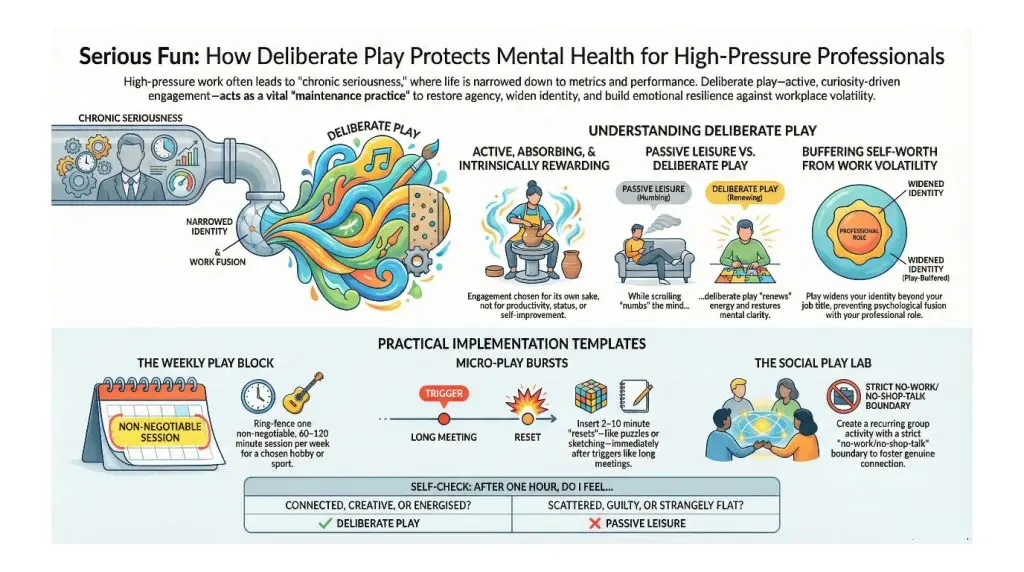
Serious fun matters more than ever when your days are packed with responsibility and decision‑making. Deliberate play is active, absorbing and intrinsically rewarding activity chosen for its own sake. Unlike passive downtime, which numbs, deliberate play renews: it widens your identity beyond your role, restores agency, interrupts rumination and builds tolerance for low‑stakes novelty. This guide defines it, shows how it differs from passive leisure, and gives you four templates you can start this week.
What is “deliberate play”?
Deliberate play is active, absorbing and intrinsically rewarding activity you choose for its own sake, not for productivity, status or self‑improvement. It has three key features:
- You are actively engaged (mentally, physically or both), not just consuming.
- There is some element of exploration, challenge or creativity.
- The primary goal is enjoyment and curiosity, not achievement or optimisation.
For high‑pressure professionals, deliberate play is the opposite of “squeezing in one more productive thing”. It is a protected space where it is safe to be non‑efficient, experimental and occasionally bad at something.
Play vs passive leisure
Not all rest is created equal. A lot of what passes as “relaxing” for busy professionals is actually low‑quality recovery.
| Passive leisure | Deliberate play | |
|---|---|---|
| Examples | Scrolling, binge‑watching, background TV, aimless web surfing, comfort snacking, drinking to unwind | Board games with friends, learning an instrument, pickup sport, creative writing, dancing, improv, Lego or model kits, genuinely playing with your children |
| Effort to start | Easy; no planning required | Some planning and intention |
| How you feel after | Dulled, scattered, strangely flat | Connected, creative, energised |
| Net effect | Numbs | Renews |
Both have a place, but they are not interchangeable. A useful self‑check: after an hour of this activity, do I feel more connected, creative or energised? If yes, it is likely play. If I feel more scattered, guilty or strangely flat, that is a warning sign that my “rest” has drifted into passive escape.
How deliberate play protects mental health
High‑pressure work tends to narrow life into a few channels: email, meetings, metrics and family logistics. Over time this creates a psychological pattern of chronic seriousness, where everything feels like a project, a risk or a performance. Deliberate play counteracts that in several ways:
- It widens your identity beyond your role. When you are a guitarist, swimmer, chess player or improviser for a few hours a week, you are no longer psychologically fused with being a manager, founder or professional. This buffers self‑worth from work volatility.
- It restores a sense of agency. Play is chosen, not assigned. In many careers, most of your calendar is reactive. Play reintroduces spaces where you decide the rules, pace and level of challenge.
- It interrupts ruminative loops. Absorbing play (flow) recruits attention so fully that worry and self‑criticism temporarily lose their grip. This is not avoidance; it is a healthy reset that often allows you to return with a clearer perspective.
- It introduces safe novelty and experimentation. Many mental health difficulties are amplified by rigid routines and avoidance of uncertainty. Play lets you practise being with mild risk and surprise in a low‑stakes context.
For midlife professionals facing cognitive load, role strain and background anxiety, deliberate play is not indulgence; it is a maintenance practice for mood, resilience and long‑term performance, and one of the most effective forms of active recovery and down‑regulation.
Four templates for deliberate play
Below are practical, “plug‑and‑play” templates you can adapt. You do not need all of them. Choosing one and running a 30‑day experiment is enough to start.
Template 1: The Weekly Play Block
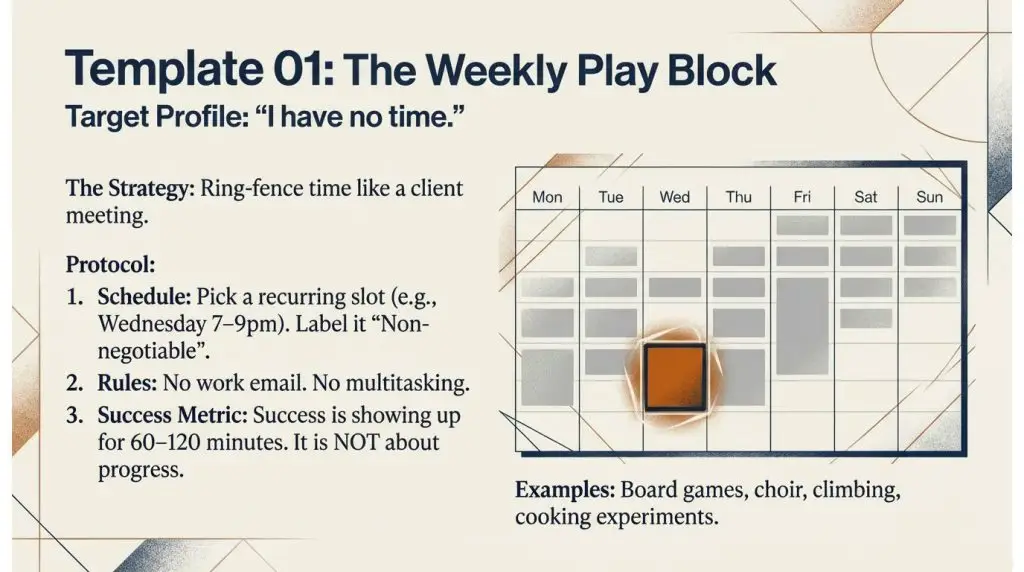
This template is for people who say, “I would love to do something fun, but I never have time.”
Goal: ring‑fence one meaningful block of play per week, the way you would protect an important meeting.
- Choose your play domain. Social: board games, improv, language class, group sport, choir. Creative: drawing, music, photography, cooking experiments, woodworking. Physical: dance, climbing, martial arts, casual sports.
- Schedule a recurring block. Pick a realistic slot (e.g. Wednesday 7–9pm or Sunday 10–12). Put it in your calendar as “Non‑negotiable Play Block” and treat it like a client commitment.
- Set ground rules. No work email or “just finishing this deck” during the block. No multitasking. Your only job is to show up and engage; the outcome does not matter.
- Define success in advance. Success is “I spent 60–120 minutes absorbed in a chosen activity”. It is not measurable progress, skill improvement or impressing anyone.
30‑day experiment: in weeks 1–2, keep the same activity each week to lower friction. In weeks 3–4, decide whether to deepen that activity or rotate to a different one. At the end, ask: how do my mood and energy feel on weeks when I honour the block versus when I don’t?
Template 2: Micro‑Play Bursts in the Workday
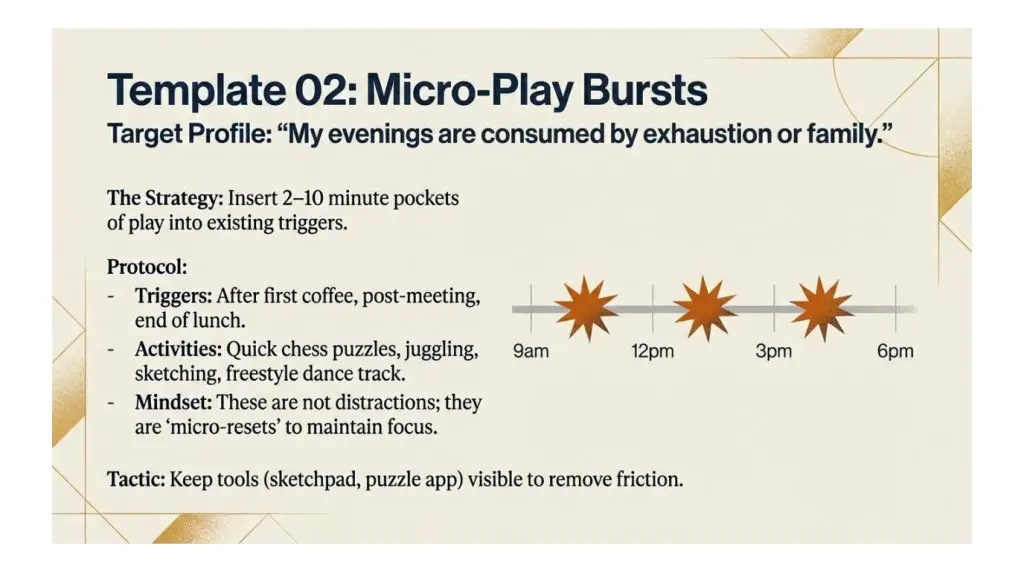
This is for people whose evenings are often consumed by family commitments or exhaustion.
Goal: insert tiny pockets of play into your existing day without waiting for “spare time”.
- Define your micro‑plays (2–10 minutes each). Mental: quick chess puzzles, word games, a silly cartoon, a mini creative writing prompt. Physical: juggling practice, freestyling to a dance track, a few minutes of a ball game with a colleague or family member. Sensory or creative: doodling, Lego bricks on your desk, origami, a little music practice.
- Attach them to existing triggers. After your first coffee, after a long meeting, or at the end of your lunch break before you check email.
- Remove friction. Keep whatever you need (travel chess board, sketchpad, instrument, puzzle app) visible and ready. Pre‑decide: “When X happens, I do Y for 5 minutes.”
- Protect them from guilt. These are not distractions; they are micro‑resets that maintain focus and reduce stress. If guilt arises, notice it and complete the 5 minutes anyway; you are rewiring the habit that everything must be productive.
30‑day experiment: aim for 1–3 micro‑play bursts per day. At the end of each week, rate your average stress and focus (0–10) and watch for small but reliable improvements.
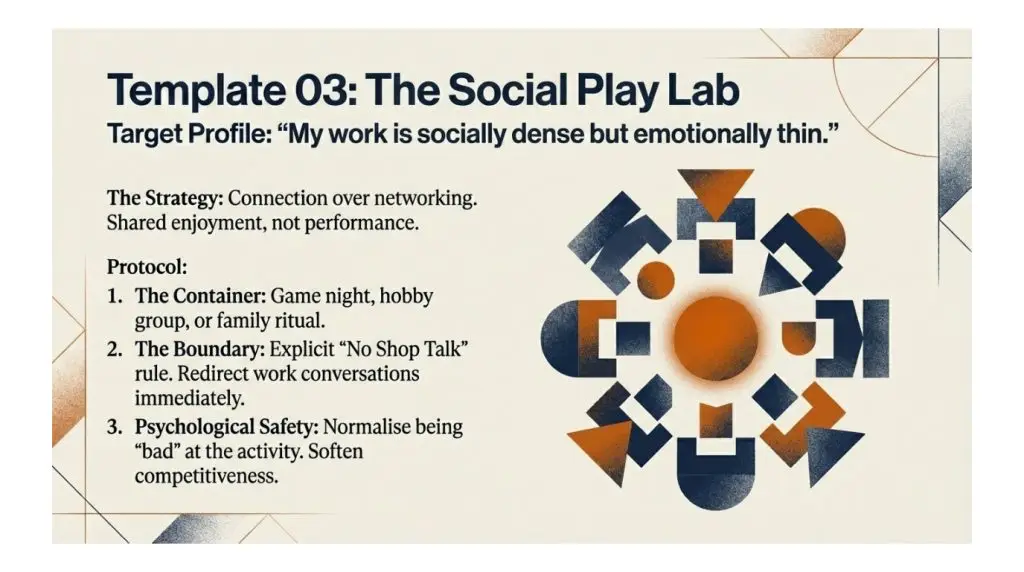
Template 3: The Social Play Lab
This template suits people whose work is socially dense (meetings, stakeholders) but emotionally thin (little genuine connection).
Goal: build one recurring social play context that is about shared enjoyment, not networking or performance.
- Pick the container. A game night (board or card games), a hobby group (a running club with a “no pace flexing” rule, a book club, cooking evenings) or a family play ritual (Saturday morning Lego, Sunday afternoon park games, walks with playful challenges).
- Clarify the “no‑work” boundary. Agree explicitly that this space is not for shop talk, complaining about work or one‑upmanship. If work comes up, redirect: “Let’s park that for Monday; tonight is for being terrible at Catan.”
- Make it easy to host. Rotate venues or keep it simple (pizza plus one game). Choose low‑set‑up activities that people can drop into without preparation.
- Focus on psychological safety. Normalise being bad at the game or activity, and gently soften competitiveness if it begins to overshadow the fun.
30‑day experiment: run the Social Play Lab weekly for a month. Notice shifts in loneliness, irritability and your sense of having “a life outside work”.
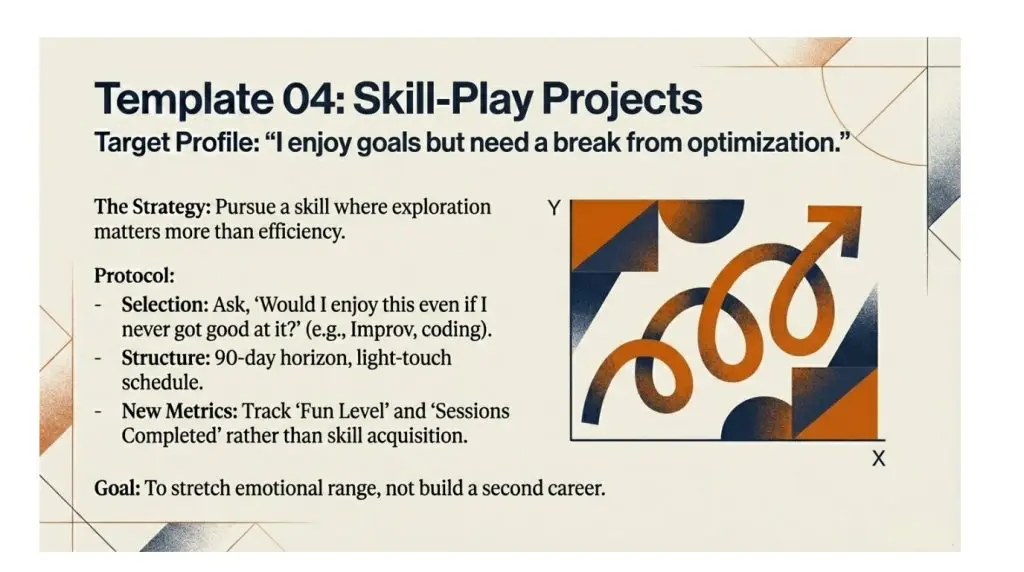
Template 4: Skill‑Play Projects
This template is ideal if you enjoy goals, but want them anchored in joy rather than optimisation.
Goal: pursue a skill that is playful by design, where exploration and creativity matter more than efficiency.
- Choose a playful skill. An instrument, drawing, improvisational theatre, casual sport, photography, creative coding or cooking a new cuisine. Ask: “Would I still enjoy this if I never got particularly good at it?”
- Set a light‑touch structure. A 90‑day horizon, with 2–3 sessions per week of 20–45 minutes, and one optional low‑stakes milestone (play a simple song to a friend, join a local jam, share a sketch, enter a friendly match).
- Keep metrics playful. Track “sessions completed” and “fun level” rather than performance. After each session, note one moment of curiosity, amusement or surprise.
- Guard against perfectionism. When self‑criticism shows up (“You’re not talented”, “You started too late”), treat it as background noise, not a signal to stop. The point is not to build a second career; it is to stretch your emotional and cognitive range.
90‑day experiment: at the end of three months, review: do I feel more playful, more confident in trying new things and less rigid about “needing to excel”?
Putting it into your life
If you are already stretched, this may sound like “one more thing you’re failing to do”. To avoid that trap:
Strategic Briefing: Start Small
- Start with one template only.
- Define a minimum effective dose (e.g. 60 minutes per week, or two 5‑minute bursts per day). Our guide to designing a play budget shows how to set one.
- Run a time‑boxed experiment (30 or 90 days) instead of making an open‑ended commitment.
- Label play blocks in your calendar in a way that reminds you why they matter (e.g. “Mental health maintenance”, “Serious fun”).
The practical question is not “Do I deserve this?” but “What kind of mind do I want to bring to my work, my relationships and my own ageing?” Deliberate play is one of the simplest, most underused levers you have to make that mind lighter, more resilient and more fully alive.
Related: This briefing is part of the Play pillar. For how Mind, Body and Play fit together, see The Executive’s Guide to Healthspan.
Evidence & Citations
- Pressman, S. D., Matthews, K. A., Cohen, S., et al. (2009). “Association of enjoyable leisure activities with psychological and physical well-being.” Psychosomatic Medicine. View Study
- Kuykendall, L., Tay, L., & Ng, V. (2015). “Leisure engagement and subjective well-being: A meta-analysis.” Psychological Bulletin. View Study
- Fancourt, D., & Tymoszuk, U. (2019). “Cultural engagement and incident depression in older adults: evidence from the English Longitudinal Study of Ageing.” British Journal of Psychiatry. View Study
- Paillard-Borg, S., Fratiglioni, L., Winblad, B., & Wang, H. X. (2009). “Leisure activities in late life in relation to dementia risk: principal component analysis.” Dementia and Geriatric Cognitive Disorders. View Study
- Schuch, F. B., Vancampfort, D., Firth, J., et al. (2018). “Physical activity and incident depression: a meta-analysis of prospective cohort studies.” American Journal of Psychiatry. View Study
- Csikszentmihalyi, M. (1990). Flow: The Psychology of Optimal Experience. New York: Harper & Row.