Executive Summary
- The “use it” principle: socialising is a complex cognitive task. It requires memory, attention and emotional processing, acting as a workout for your brain.
- Cortisol buffer: meaningful connection lowers the chronic stress that otherwise fogs the midlife brain and affects the hippocampus.
- Quality over quantity: you don’t need a crowded party. Deep, one‑to‑one engagement provides the strongest benefits.
As professionals, we are excellent at optimising. We track our sleep, we prioritise protein and we schedule our workouts. Yet in the busy transition of midlife (between career peaks, ageing parents and perhaps an emptying nest) we often view socialising as a “nice to have” rather than a biological necessity.
If you have been feeling that creeping sense of brain fog, or finding it harder to recall names and words, the solution might not be another supplement. It might be a conversation. Today, let’s explore social engagement as a critical pillar of cognitive resilience. (For the physical‑health side of the story, see social connection and vitality.)
The Neuroscience of a Chat: It’s Not Just “Small Talk”
We tend to think of thinking as a solitary act: writing a report or solving a puzzle. But biologically, our brains evolved to navigate the complex web of a tribe.
When you engage in a meaningful conversation, your brain is performing a high‑wire act. You are listening (auditory cortex), interpreting tone (amygdala), remembering context (hippocampus) and formulating a response (prefrontal cortex), all in real time. This is cognitive load training.
For the midlife brain, which thrives on neuroplasticity (the ability to form new connections), isolation is essentially bed rest for your neurons. Engagement is the gym.
Your Internal “Stress Buffer” (Cortisol Regulation)
There is another layer to this. Midlife is often a high‑cortisol season, and chronic stress is hard on the brain, particularly the areas responsible for memory.
Strategic Briefing: How Connection Protects the Executive Brain
- Lowers inflammation: positive social interactions are associated with lower levels of interleukin‑6, an inflammatory marker linked to cognitive decline.
- Releases oxytocin: this counters cortisol, helping to clear the fog caused by anxiety and stress.
- Builds cognitive reserve: a rich social life builds a buffer that allows the brain to cope better with ageing or pathology.
What the Data Says (Realistically)
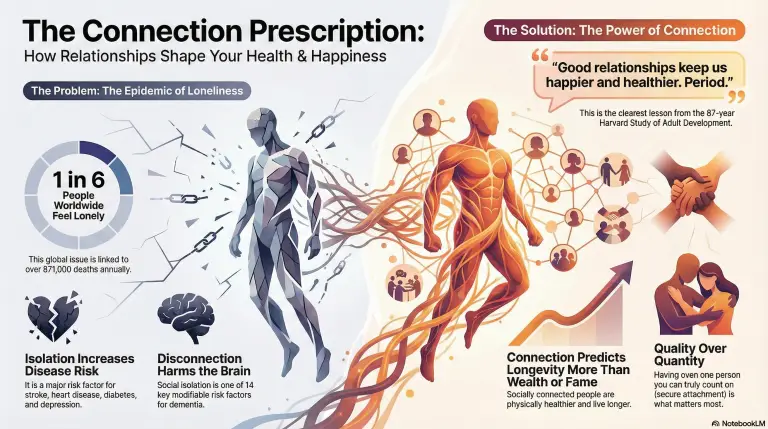
This isn’t just a warm sentiment. The Lancet Commission on dementia prevention lists social isolation as one of the modifiable risk factors for dementia.
- The risk factor: large studies link loneliness and social isolation with a substantially higher risk of dementia, alongside poorer sleep, executive function and wellbeing.
- The protective effect: maintaining a social network through your 50s and 60s is associated with better memory and slower cognitive ageing.
Safety & Nuance: Introverts, Take Heart
A crucial distinction: social engagement is not the same as social exhaustion.
For many of us, energy is precious. You do not need to fill your calendar with drinks receptions to get these benefits. Research on loneliness points to the quality of connection, not the quantity: a one‑hour coffee with a close friend where you feel understood counts for far more than three hours of superficial networking.
If you are an introvert, protect your energy. Aim for “low dose, high depth” interactions.
The Bottom Line
As we navigate the second half of life, our definition of “health” must expand beyond diet and exercise. Your calendar is a tool for brain health. Prioritise that lunch date, make that phone call or join that community group (a language class doubles as cognitive training). Your brain will thank you for the workout.
Related: This briefing is part of the Mind pillar. For how Mind, Body and Play fit together, see The Executive’s Guide to Healthspan.
Evidence & Citations
- Livingston, G., Huntley, J., Sommerlad, A., et al. (2020). “Dementia prevention, intervention, and care: 2020 report of the Lancet Commission.” The Lancet. View Study
- Cacioppo, J. T., & Cacioppo, S. (2014). “Social relationships and health: the toxic effects of perceived social isolation.” Social and Personality Psychology Compass. View Study