
Flow States & Deep Play: The Cognitive Reset

Executive Summary
In a high-pressure environment, “rest” is often mistaken for passivity (scrolling, watching TV). However, true cognitive recovery requires Deep Play—activities that induce a “Flow State.” Flow is a psychological state of total immersion where the “Executive Self” quiets down, allowing for peak creativity and the clearing of mental fatigue. This protocol treats Flow as a strategic tool for both high-level output and biological resilience.
During Deep Play, the brain enters a state of Transient Hypofrontality. This is the temporary deactivation of the prefrontal cortex—the area responsible for your ‘inner critic,’ self-consciousness, and complex planning. By manually ‘shutting down’ this high-energy center, you allow the rest of your brain to reset and recover from executive fatigue.
The Problem: The “Cognitive Residue” of Passive Rest
Most professionals attempt to recover using “Passive Play” (social media, streaming). While these activities offer a temporary dopamine hit, they do not provide a neurological reset.
The “Always-On” Drain: Passive rest allows the brain to continue “looping” on work problems in the background.
The Biological Cost: Without the deep immersion of Flow, the brain’s prefrontal cortex remains overactive, leading to decision fatigue and a sense of “mental staleness.”
THE Strategic briefing: the FLOW STATE
The Concept: Flow is a state of Total Immersion where your sense of self vanishes and time seems to distort. It is the most efficient state the human brain can inhabit.
The Digital Sabbath: Protecting the Container
The Concept: Flow cannot coexist with interruptions. A “Digital Sabbath” is a pre-scheduled, non-negotiable window where all professional communication devices are powered down.
The Action: Set a weekly 4-hour block (e.g., Saturday mornings) of “Zero-Input” time. No emails, no news feeds, no social media.
The Science: A single notification doesn’t just distract you for a second; it leaves “Attention Residue” that can take up to 20 minutes to clear. The Digital Sabbath eliminates this residue, allowing the brain to drop into Transient Hypofrontality (the quietening of the inner critic) much faster.
The Mechanics:
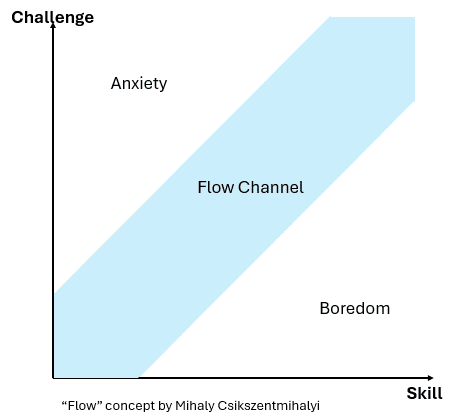
Challenge vs. Skill: Flow exists in the “Sweet Spot”—where the task is difficult enough to demand 100% focus but not so hard that it causes anxiety.
Hypofrontality: During flow, the “Inner Critic” (Prefrontal Cortex) temporarily shuts down. This allows for rapid, automatic processing and peak creativity.
- The Mechanism: Flow induces Transient Hypofrontality, a biological ‘power down’ of the logical brain that silences self-doubt and triggers peak creativity.
The Executive ROI: Active Play isn’t a distraction; it is a Cognitive Palate Cleanser. It flushes out “Decision Fatigue” and allows your brain to consolidate complex data in the background, leading to sudden strategic breakthroughs.
The Deep Play Protocol
To achieve a Flow state, we must engage in “Active Play”—tasks that require high focus and high skill, but carry zero professional consequence.
1. The High-Challenge / High-Skill Balance
Flow occurs at the intersection of a significant challenge and a developed skill. If the task is too easy, you are bored; if it’s too hard, you are anxious.
The Action: Identify a “Flow Trigger” activity. This could be mountain biking, playing a musical instrument, woodworking, or complex strategy games.
The Goal: Choose an activity where the “feedback loop” is immediate and requires 100% of your attention.
2. The “Digital Sabbath” for Deep Play
Flow cannot coexist with interruptions. A single notification can shatter a Flow state and take up to 20 minutes to recover the same depth of focus.
The Action: Set a “No-Input” window of 2–4 hours weekly. During this time, all professional devices are powered down.
The ROI: This creates the “Psychological Safety” required for the brain to enter deep immersion.
3. The “Play” Audit
We often view “unproductive” time as a waste. Biologically, it is a reinvestment.
The Action: Audit your hobbies. Are they Active (challenging, skill-based, immersive) or Passive (low-effort, distracting)?
The Goal: Aim for one 90-minute “Deep Play” session per week. This acts as a “brain flush,” resetting your creative capacity for the upcoming work week.
🧬 The Science of the “Quiet Mind”: Transient Hypofrontality
While “Flow” sounds like a mystical state, it has a concrete biological basis called Transient Hypofrontality—a term coined by neuroscientist Arne Dietrich.
Transient: Temporary.
Hypo: Down-regulation or slowing down.
Frontality: Referring to the Prefrontal Cortex (PFC).
What’s happening? During high-intensity “Deep Play” or flow states, your brain efficiently reallocates energy. It temporarily deactivates the Prefrontal Cortex—the seat of higher-order cognitive functions like self-reflection, complex integration, and your “inner critic.”
The Result: When the Prefrontal Cortex goes quiet, the “voice” in your head that judges your performance or worries about the future disappears. This allow your basal ganglia and sensory centers to take over, leading to the distorted sense of time and peak creativity associated with the “Zone.”
The Biological ROI
Neural Efficiency: During Flow, the brain switches from “explicit” (slow, effortful) processing to “implicit” (fast, automatic) processing, significantly reducing energy expenditure.
Dopamine & Endorphin Release: Flow states trigger a potent neurochemical cocktail that boosts mood and increases the “height” of your focus for days afterward.
Stress Resilience: Through the process of Transient Hypofrontality, the brain’s executive centers receive a mandatory break. This lowers systemic cortisol and provides a total autonomic reset, preventing the mental staleness of the ‘always-on’ leader.
🔬
Evidence & Citations
This article is based on scientific evidence and fact-checked by our editorial team. We prioritize peer-reviewed studies, clinical trials, and academic consensus.
Csikszentmihalyi, M. (1997). “Finding Flow: The Psychology of Engagement with Everyday Life.” Basic Books / Psychology Today Archive. View Study
- Gold, J. & Ciorciari, J. (2020). “A Review on the Role of the Neuroscience of Flow States in the Modern World.” Frontiers in Human Neuroscience. View Study
Dietrich, A. (2004). “Neurocognitive mechanisms underlying the experience of flow.” Consciousness and Cognition. View Study