
Executive Summary
Cortisol is not your enemy — chronic elevation is. In acute, well-timed bursts it sharpens focus and mobilises energy; left dysregulated across months and years, it becomes the silent tax on your sleep, your waistline, your memory, and ultimately your judgement. For the high-performing professional living in a state of perpetual arousal, the single highest-leverage intervention is restoring the natural rhythm of cortisol — high in the morning, low at night. Master that rhythm, and you shift from reactive to responsive, protecting both your performance today and your healthspan for decades.
Cortisol as a Strategic Variable
In the boardroom we talk endlessly about “managing stress” and almost never about the biochemistry driving it. That’s a mistake. Cortisol is a steroid hormone produced by the adrenal glands, and it operates on a strict circadian schedule: it should peak roughly 30 minutes after waking — the Cortisol Awakening Response (CAR) — and bottom out in the hours before sleep to permit cellular repair.
The modern executive breaks this pattern daily. Back-to-back meetings, a phone that never stops, late-night screens, and a nervous system that treats every unread email as a sabre-toothed tiger. When cortisol never drops, your body remains locked in survival mode — prioritising immediate energy mobilisation over the long-term maintenance that underpins a long, high-functioning life. The goal is not to be perpetually calm. It is to be appropriately aroused and then to recover fully.
The Science: The HPA Axis and Allostatic Load
To regulate cortisol, you must understand the HPA axis — the Hypothalamic-Pituitary-Adrenal loop that functions as your body’s central stress command system.
The Amygdala Hijack
When your brain perceives threat — a slipped deadline, a hostile board member — the amygdala triggers the HPA cascade, flooding your system with cortisol and adrenaline. Blood is diverted to large muscle groups. Digestion, immune repair, and the slow, associative thinking that produces genuine insight are all suppressed. Useful for a sprint. Catastrophic as a lifestyle.
Allostatic Load
Coined by the late Bruce McEwen of Rockefeller University, allostatic load describes the cumulative biological “wear and tear” of repeated stress activation. Think of cortisol as high-octane fuel: run the engine on it 24/7 and the engine degrades. High allostatic load is the physiological substrate of the “tired but wired” state that precedes clinical burnout.
Hippocampal Erosion
The hippocampus — your centre for memory consolidation and emotional regulation — is densely populated with glucocorticoid receptors, making it acutely vulnerable to chronic cortisol. Sapolsky’s primate work and subsequent human studies demonstrate that sustained elevation can measurably reduce hippocampal volume, impairing both learning and your ability to stay composed under pressure. The very faculties your career depends on are the ones cortisol attacks first.
Pillar 1: Circadian Alignment — The Morning Anchor
The most effective lever for cortisol regulation is anchoring your internal clock. When your brain knows precisely when the day begins, it can far more reliably execute the evening taper.

- View morning sunlight: Get 5–10 minutes of direct outdoor light within 30 minutes of waking (longer on overcast days). This triggers a healthy, well-timed CAR, clears adenosine, and sets the melatonin timer for roughly 16 hours later.
- Delay caffeine 90 minutes: Let your natural cortisol do its job first. Front-loading caffeine blunts the natural CAR and sets you up for an afternoon crash followed by a compensatory secondary cortisol spike.
- Hydrate on waking: Overnight dehydration is itself a mild physiological stressor. Front-load 500ml of water with a pinch of salt.
Pillar 2: Nutritional Interventions for Cortisol Control
What you eat — and when — sends direct signals to your adrenals.
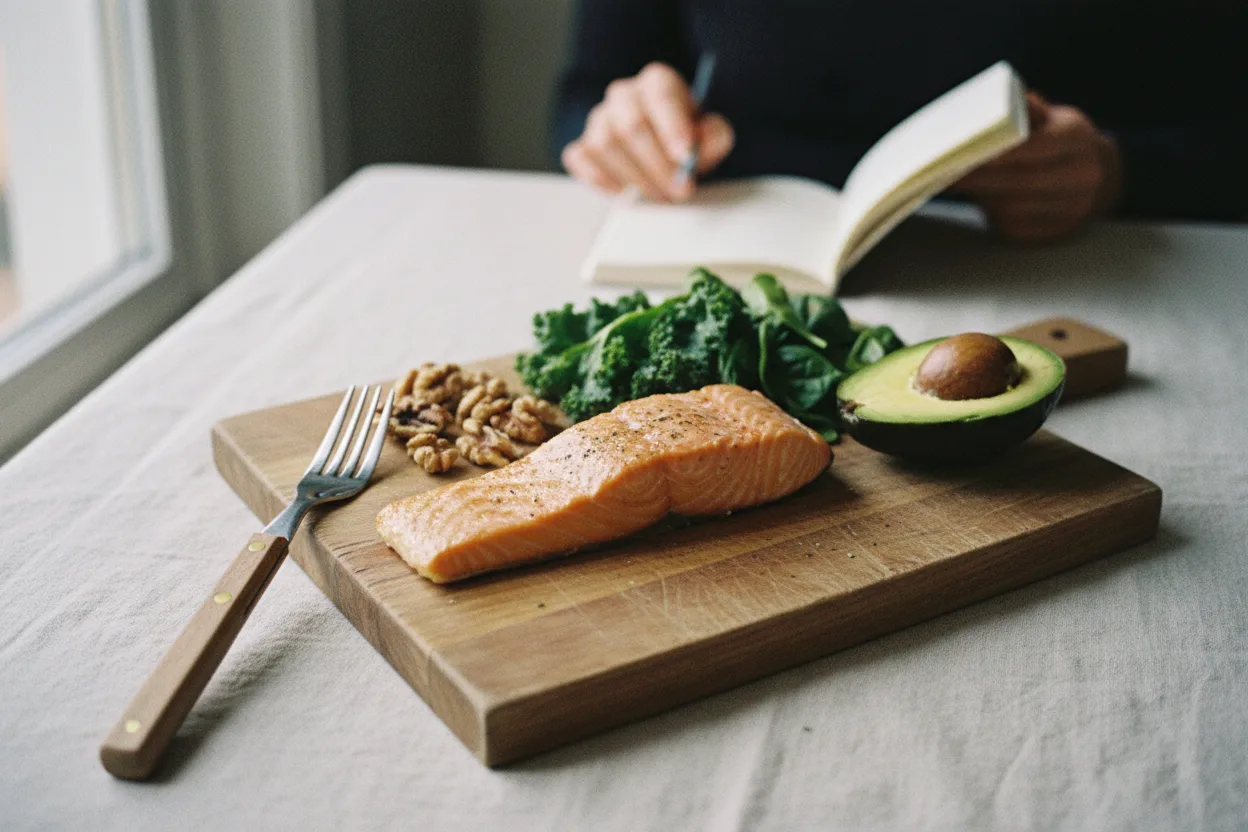
- Stabilise blood glucose: Every glucose crash triggers a cortisol release to restore blood sugar. Build meals around protein and fibre to eliminate these recurring metabolic stress events — the hidden cortisol spikes most executives never notice.
- Vitamin C: The adrenal cortex holds one of the highest vitamin C concentrations in the body, and these stores deplete under sustained stress. 500–1000mg daily can modestly blunt the cortisol response to acute stressors.
- Magnesium glycinate: Magnesium helps regulate HPA axis reactivity and promotes muscular and neural relaxation. 200–400mg in the evening supports the nightly cortisol decline. The glycinate form is well-absorbed and gentle on the gut. It features in our Executive Supplement Stack.
- Moderate alcohol ruthlessly: Alcohol feels sedating but provokes a significant cortisol rebound as it is metabolised — the mechanism behind the 3am wake-up with a racing heart.
Pillar 3: Real-Time Down-Regulation — The Parasympathetic Toolkit
You cannot eliminate workplace stress. You can change your physiological response to it in real time. For the wider set of tools, see our stress protocols and cortisol management guide.
The Physiological Sigh
Characterised in the research of Jack Feldman at UCLA and popularised by Andrew Huberman at Stanford, this is the fastest known way to downshift the nervous system in real time.
- Execution: Two inhales through the nose — a full first breath, then a second short “top-up” that re-inflates collapsed alveoli — followed by a long, slow exhale through the mouth.
- Deployment: Between back-to-back meetings, or the instant you feel your chest tightening under pressure. Three to five rounds is enough to lower heart rate and restore executive function.
Box Breathing
A staple of elite military training, box breathing balances CO2 and oxygen and reliably engages the parasympathetic branch.
- Execution: Inhale 4 seconds, hold 4, exhale 4, hold 4. Repeat for 4–5 cycles.
Pillar 4: Strategic Recovery — Thermal and Physical
Paradoxically, the right dose of external stress trains the system to recover faster from internal stress — the principle of hormesis.
- Sauna therapy: 20 minutes at 80°C+, used 3–4 times weekly, upregulates heat shock proteins, reduces systemic inflammation, and is associated in Finnish cohort data with substantially lower cardiovascular and all-cause mortality.
- The cold finish: A 1–2 minute cold exposure at the end of your morning routine drives a sustained norepinephrine release that buffers you against the emotional stressors of the day ahead.
- Zone 2 movement: Unlike maximal-intensity work, which acutely spikes cortisol, steady-state aerobic activity helps clear circulating cortisol and lowers overall allostatic load. A daily walk is not optional for the chronically stressed executive — it is medicine.
Pillar 5: The Digital Sunset and Sleep Architecture
Cortisol and melatonin are antagonists — when one rises, the other falls. Bright, blue-enriched screen light in the late evening is interpreted by the brain as midday, suppressing melatonin and sustaining cortisol precisely when it should be at its nadir.
- Analogue hour: No screens for 60 minutes before bed. If unavoidable, use blue-light filters and dim the room.
- The brain dump: Write down tomorrow’s top three priorities. Externalising these “open loops” prevents the cortisol-driven 3am rumination wake-up.
- Temperature modulation: Keep the bedroom around 18°C. A falling core temperature is a biological prerequisite for sleep onset and the overnight cortisol taper.
A Practical Daily Routine for Cortisol Management
- 07:00 — Sunlight + hydration: Trigger a clean Cortisol Awakening Response.
- 08:30 — First coffee: Caffeine delayed ~90 minutes to protect natural focus.
- 13:00 — 10-minute Zone 1–2 walk: Metabolic cortisol clearance.
- 16:00 — Physiological sigh (×3–5): Mid-afternoon HPA reset.
- 20:00 — Final meal (protein + fibre): Prevent nocturnal glucose crash and cortisol rebound.
- 21:30 — Digital sunset + magnesium glycinate: Suppress cortisol, support melatonin.
Frequently Asked Questions
Does alcohol help with stress?
No — this is one of the most expensive misconceptions in executive life. It is tempting to reach for a glass of wine after a challenging day. Alcohol feels sedating, but as the body metabolises it, cortisol rises sharply. This is why you wake at 3am with a racing heart and fragmented sleep after an evening of drinking.
What is “tired but wired”?
A state in which the body is exhausted yet the HPA axis remains stuck in high arousal. It is a primary warning sign of impending burnout. If you recognise it in yourself, prioritise Pillars 1 and 5 immediately — circadian anchoring and sleep architecture.
Are adaptogens like ashwagandha safe?
Ashwagandha (Withania somnifera) is among the most robustly studied botanicals for cortisol reduction, with multiple randomised trials showing meaningful decreases in serum cortisol and perceived stress. It is generally well-tolerated; cycling (for example five days on, two off) can help preserve natural emotional responsiveness. If you have thyroid conditions or take sedatives, consult your GP first.
How do I know if my cortisol is elevated without a lab test?
Common signals include accumulating abdominal (visceral) fat despite stable diet, poor sleep quality, a jittery or “shaky” reaction to caffeine, and the characteristic tired-but-wired fatigue. For objective data, a four-point salivary cortisol curve or a serum morning cortisol is worth requesting from your GP.
The Bottom Line
- Anchor your morning. Sunlight within 30 minutes of waking and delayed caffeine are the two highest-leverage moves for restoring cortisol rhythm.
- Protect the taper. A 60-minute digital sunset, a cool bedroom at 18°C, and evening magnesium glycinate allow cortisol to fall and sleep to repair.
- Train real-time recovery. Deploy the physiological sigh and box breathing between meetings to convert reactivity into responsiveness.
- Use hormesis strategically. Sauna 3–4 times weekly and daily Zone 2 movement lower baseline allostatic load.
- Stabilise your fuel. Protein- and fibre-led meals, minimal alcohol, and consistent meal timing eliminate the hidden metabolic cortisol spikes most executives never detect.
Related: This briefing is part of the Mind pillar. For how Mind, Body and Play fit together, see The Executive’s Guide to Healthspan.
Evidence & Citations
- McEwen, B. S. (2007). “Physiology and neurobiology of stress and adaptation: central role of the brain.” Physiological Reviews. View Study
- Sapolsky, R. M. (2000). “Glucocorticoids and hippocampal atrophy in neuropsychiatric disorders.” Archives of General Psychiatry. View Study
- Balban, M. Y., Neri, E., Kogon, M. M., et al. (2023). “Brief structured respiration practices enhance mood and reduce physiological arousal.” Cell Reports Medicine. View Study
- Laukkanen, T., Khan, H., Zaccardi, F., & Laukkanen, J. A. (2015). “Association between sauna bathing and fatal cardiovascular and all-cause mortality events.” JAMA Internal Medicine. View Study
- Chandrasekhar, K., Kapoor, J., & Anishetty, S. (2012). “A prospective, randomized double-blind, placebo-controlled study of safety and efficacy of a high-concentration full-spectrum extract of ashwagandha root in reducing stress and anxiety in adults.” Indian Journal of Psychological Medicine. View Study
- Clow, A., Hucklebridge, F., Stalder, T., Evans, P., & Thorn, L. (2010). “The cortisol awakening response: more than a measure of HPA axis function.” Neuroscience & Biobehavioral Reviews. View Study
- Boyle, N. B., Lawton, C., & Dye, L. (2017). “The effects of magnesium supplementation on subjective anxiety and stress — a systematic review.” Nutrients. View Study
- Spiegel, K., Leproult, R., & Van Cauter, E. (1999). “Impact of sleep debt on metabolic and endocrine function.” The Lancet. View Study