
High-Performance Longevity for Professionals
The Executive's Guide to Healthspan:
Strategies for Peak Performance and Longevity
Practical strategies to improve energy, cognitive performance and long-term healthspan.
Executive Summary
For the high-performer, health is the only asset that cannot be outsourced. Our goal is the Compression of Morbidity: keeping functional capacity high until the very end.
The purpose of this guide is to provide a structured, evidence-based framework for extending healthspan—the period of life spent in optimal physical and cognitive health.
For high-performing professionals, health is often the most undervalued asset. While modern medicine excels at extending lifespan (the total years lived), it frequently fails to prevent the “diseasespan”—the final decades often defined by chronic illness and cognitive decline.
This guide outlines the biological drivers of aging and provides actionable protocols to help you maintain peak performance well into your later years. By focusing on metabolic health, physical conditioning, and cellular repair, you can effectively “compress morbidity,” ensuring your final years are as vibrant as your current ones.
Introduction: Why Healthspan is the Ultimate Executive KPI
What is Healthspan?
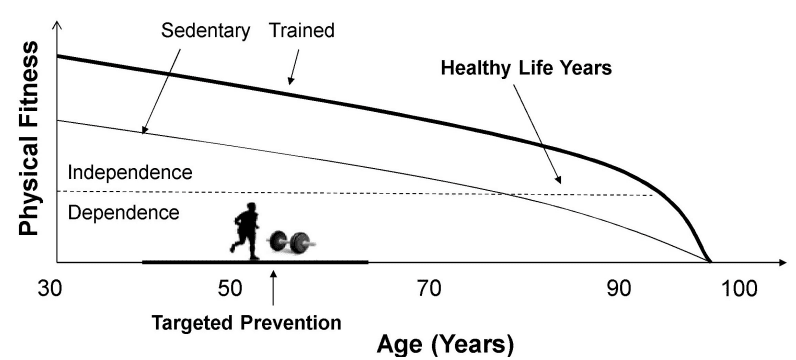
Healthspan is the length of time an individual remains healthy, active, and free from chronic disease. The challenge we face today is that while we are living longer, we are not necessarily living better. Many professionals spend their final 15 to 20 years managing preventable conditions like Type 2 diabetes, cardiovascular disease, or neurodegeneration.
The Goal: Compression of Morbidity
Our objective is to maximize the area under the curve of your health. By implementing strategic lifestyle interventions now, we aim to keep your functional capacity high until the very end of life, shortening the period of decline to a matter of weeks or months rather than decades.
The Science of Aging: Understanding the Biological Drivers
To manage aging effectively, we must understand its underlying mechanisms. Science has identified several “hallmarks of aging”—biological processes that contribute to the functional decline of cells and tissues.
Mitochondrial Dysfunction (The Power Plant)
Mitochondria are the power plants of your cells. They convert nutrients into ATP, the energy currency of the body. As we age, mitochondrial efficiency tends to drop, leading to decreased physical stamina and "brain fog." Optimizing these organelles is essential for maintaining the high energy levels required for leadership.
Cellular Senescence (The "Zombie Cell" Problem)
Over time, some cells stop dividing but refuse to die. These are known as senescent cells. They linger in the body, secreting inflammatory signals that damage neighbouring healthy cells. This accumulation is a primary driver of systemic inflammation and tissue breakdown.
Inflammaging (The Silent Fire)
"Inflammaging" refers to the low-grade, chronic inflammation that develops with age. Unlike the acute inflammation you feel after an injury, this is silent and systemic. It is a major risk factor for heart disease, Alzheimer’s, and metabolic syndrome.
Proteostasis (The Quality Control)
Your body relies on a system of "quality control" to repair or recycle damaged proteins. When this system (proteostasis) fails, misfolded proteins accumulate. This is a hallmark of neurodegenerative diseases. We use processes like autophagy—the body's internal recycling program—to clear this debris.
The Six Pillars of Healthspan
Pillar 1: Metabolic Health and Glucose Regulation
Metabolic health is the cornerstone of longevity. If your metabolism is dysregulated, every other health intervention will have a diminished return.
Key Metrics to Monitor:
- HbA1c: A 3-month average of blood sugar levels.
- Fasting Insulin: An early indicator of insulin resistance.
- ApoB: A more accurate marker of cardiovascular risk than standard LDL cholesterol.
Actionable Strategy: Time-Restricted Feeding (TRF)
Implementing a consistent 12 to 14-hour overnight fast allows insulin levels to drop and triggers cellular repair mechanisms. For most executives, an 8:00 PM to 8:00 AM or 10:00 AM fasting window is manageable and highly effective for maintaining insulin sensitivity.
Pillar 2: Resistance Training and Structural Capital
Muscle mass is one of the strongest predictors of all-cause mortality. It acts as a metabolic “sink,” absorbing excess glucose and protecting your hormonal health.
The Protocol:
- Frequency: 3 sessions per week.
- Focus: Compound movements (squats, deadlifts, presses, and pulls). These movements recruit the most muscle fibers and elicit the greatest metabolic response.
- Goal: Maintain or increase lean muscle mass to prevent sarcopenia (age-related muscle loss.
Pillar 3: Cardiorespiratory Fitness and VO2 Max
Your VO2 Max—the maximum amount of oxygen your body can utilize during intense exercise—is a powerful proxy for your biological age. High-performing individuals should aim for a VO2 Max in the top 25th percentile for their age group.
The Protocol:
- Zone 2 Training: 150 minutes per week of steady-state aerobic activity (brisk walking or light cycling) where you can still maintain a conversation. This builds mitochondrial density.
- Vigorous Intensity: One session per week of high-intensity intervals (HIIT) to push the upper limits of your aerobic capacity.
Pillar 4: Sleep Architecture and Cognitive Recovery
Sleep is not “downtime”; it is the only time your brain’s glymphatic system flushes out metabolic waste. For an executive, sleep deprivation is a direct tax on decision-making quality and emotional regulation.
Next Steps for Sleep Optimization:
- Temperature Control: Keep your bedroom at approximately 18°C (64.5°F).
- Light Hygiene: Eliminate blue light (screens) at least 60 minutes before bed to allow melatonin production.
- Consistency: Go to bed and wake up within the same 30-minute window every day, including weekends.
Pillar 5: Nutritional Strategies for Longevity
Nutrition should be viewed as “information” for your cells. We want to provide signals that promote repair rather than growth and storage.
The “One’s Best Self” Dietary Framework:
- Protein Leverage: Aim for 1.6g to 2.2g of protein per kilogram of body weight to support muscle retention.
- Fibre Intake: Minimum of 30g per day to support gut health and reduce systemic inflammation.
- Limit Ultra-Processed Foods: These are the primary drivers of metabolic dysfunction and “inflammaging.”
Pillar 6: Stress Resilience and Cortisol Management
Chronic stress keeps the body in a state of “fight or flight,” which accelerates cellular aging. Developing a “parasympathetic toolkit” is essential for long-term healthspan.
Practical Tools:
- Box Breathing: 4 seconds in, 4 seconds hold, 4 seconds out, 4 seconds hold. This instantly signals to your nervous system that you are safe.
- Non-Sleep Deep Rest (NSDR): 10–20 minute protocols (like Yoga Nidra) can restore cognitive function during a busy workday.
Practical Protocols: Your Executive Weekly Plan
Below is an example structured weekly template that balances high-intensity work with necessary recovery. Find what works for you by focusing on what you enjoy. Consistency in these habits will yield the greatest long-term results.
| Day | Focus | Action Item |
|---|---|---|
| Monday | Strength (Lower Body) | 45 min Resistance Training + 20 min Zone 2 |
| Tuesday | Aerobic Base | 45 min Zone 2 (Walking/Cycling) |
| Wednesday | Strength (Upper Body) | 45 min Resistance Training |
| Thursday | Active Recovery | 30 min Mobility/Yoga + Long Walk |
| Friday | High Intensity | 20 min HIIT + Full Body Strength |
| Saturday | Endurance | 60–90 min Zone 2 (Hiking/Sport) |
| Sunday | Full Recovery | No structured exercise; focus on meal prep/sleep |
Monday - Strength (Lower Body)
45 min Resistance Training + 20 min Zone 2
Tuesday - Aerobic Base
45 min Zone 2 (Walking/Cycling)
Wednesday - Strength (Upper Body)
45 min Resistance Training
Thursday - Active Recovery
30 min Mobility/Yoga + Long Walk
Friday - High Intensity
20 min HIIT + Full Body Strength
Saturday - Endurance
60–90 min Zone 2 (Hiking/Sport)
Sunday - Full Recovery
No structured exercise; focus on meal prep/sleep
- Executive Longevity Blueprint
Extend Your Performance Runway
Download the Executive Longevity Blueprint—a 90-day technical protocol to audit your biomarkers, flush biological debt, and extend your performance runway.
Advancements in Longevity Science: What’s Next?
While lifestyle remains the foundation, several emerging areas of research may soon complement these protocols:
- Senolytics: Small molecules designed to clear out senescent (“zombie”) cells.
- NAD+ Precursors: Compounds that support cellular energy production and DNA repair.
- Epigenetic Clocks: Tests that measure your “biological age” based on DNA methylation patterns.
Note: These interventions should be discussed with a specialist in longevity medicine.
Frequently Asked Questions (FAQ)
What is the single most important habit for healthspan?
If you had to choose one, it is regular physical activity—specifically a combination of strength training and aerobic conditioning. This addresses metabolic health, mitochondrial function, and structural integrity simultaneously.
How does alcohol affect healthspan?
Alcohol is a potent disruptor of sleep architecture and a source of systemic inflammation. For longevity, we recommend limiting consumption to fewer than two drinks per week, ideally avoided entirely within 3 hours of sleep.
Is it too late to start?
Not at all. Research shows that even individuals in their 70s and 80s can significantly improve their muscle mass, cardiovascular health, and cognitive function through these protocols.
Should I take supplements?
Supplements should be the “last 5%” of your strategy. Focus on sleep, diet, and exercise first. If you choose to supplement, prioritize Vitamin D, Omega-3s, and Magnesium based on your blood work.
Internal Resources for Further Reading
If you found this guide helpful, you may wish to explore our more detailed protocols:
🔬
Evidence & Citations
This article is based on scientific evidence and fact-checked by our editorial team. We prioritize peer-reviewed studies, clinical trials, and academic consensus.
- López-Otín, C., et al. (2013). “The Hallmarks of Aging.” Cell.
- Barzilai, N., et al. (2016). “Targeting Aging with Metformin.” Cell Metabolism.
- Booth, F. W., et al. (2012). “Lack of exercise is a major cause of chronic diseases.” Comprehensive Physiology.
- Walker, M. (2017). Why We Sleep: Unlocking the Power of Sleep and Dreams. Penguin Books.
- Longo, V. D., & Panda, S. (2016). “Fasting, Circadian Rhythms, and Time-Restricted Feeding in Healthy Lifespan.” Cell Metabolism.