
Active Recovery & Down-Regulation: The Physiology of Detachment

Executive Summary
For the high-performer, recovery is not a passive event—it is an active biological process. True “Down-Regulation” is the ability to intentionally shift the nervous system from a Sympathetic (Fight or Flight) state to a Parasympathetic (Rest and Digest) state.
Without this transition, chronic cortisol elevation leads to “Executive Burnout,” characterized by fragmented sleep, cognitive “fog,” and systemic inflammation. This protocol provides the tools to force a physiological reset.
The Problem: The “Always-On” Feedback Loop
Modern executive life requires a state of constant “High Alert.” While this state drives productivity, the body is not designed to stay there indefinitely.
The Residual Stress Effect: Even after you stop working, the brain continues to “loop” on problems, keeping the heart rate elevated and prevent the prefrontal cortex from cooling down.
The Biological Cost: Staying “on” prevents the brain’s glymphatic system from clearing metabolic waste, leading to a decline in decision-making speed and emotional regulation.
The Anatomy of the Reset: The Craniosacral System
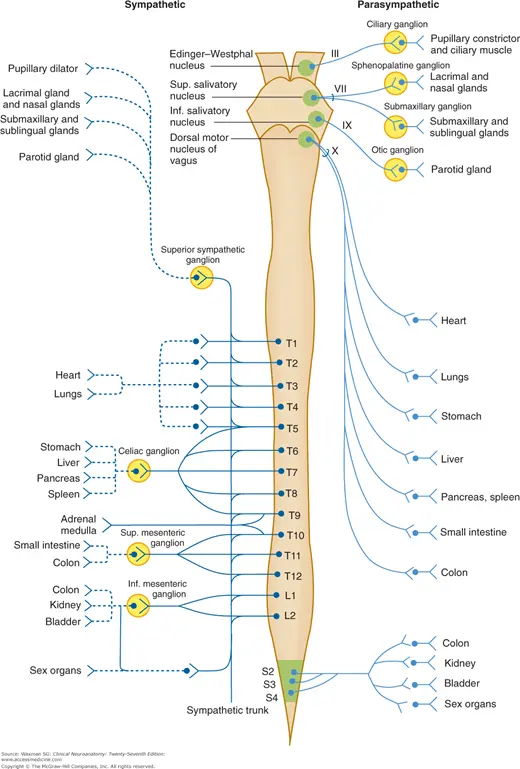
To understand Active Recovery, one must look at the dual-architecture of the Autonomic Nervous System. While the Sympathetic system (the “Gas Pedal”) acts as a unified chain for rapid energy mobilization, the Parasympathetic system (the “Handbrake”) is Craniosacral—meaning it is anchored at the two poles of your neurological axis.
1. The Cranial Outflow (The Mind-Body Bridge)
Originating in the brainstem, this is dominated by Cranial Nerve X: The Vagus Nerve. It acts as the primary “high-speed rail” for recovery signals, connecting directly to the heart, lungs, and upper digestive tract. Protocols like the Physiological Sigh work by manually stimulating this cranial pathway to drop the heart rate in seconds.
2. The Sacral Outflow (The Foundation of Vitality)
Often missing from simplified diagrams, the sacral nerves (S2–S4) emerge from the base of the spine. This region governs the “lower” systems: the colon, bladder, and reproductive organs. Chronic stress often “shuts down” blood flow to these areas (causing digestive issues and low vitality). Deep Play and movement-based recovery help re-perfuse these sacral pathways, restoring systemic balance.
The Executive Takeaway
Effective down-regulation requires addressing both ends of the circuit. By engaging in breathwork (Cranial) and active movement or posture resets (Sacral), you engage the full biological “Brake Pedal,” ensuring a complete physiological detachment from the workday.
The Down-Regulation Protocol
To achieve detachment, we use “bottom-up” physiological triggers that tell the brain the day is over.
1. Targeted Breathwork (The Handbrake)
You cannot “think” yourself into a calm state, but you can breathe yourself there.
The Action: Use the Physiological Sigh (double inhale followed by a long, slow exhale). This is the fastest way to offload CO2 and lower your heart rate.
The ROI: Two minutes of this protocol signals the vagus nerve to initiate a parasympathetic shift, immediately lowering blood pressure.
2. Non-Sleep Deep Rest (NSDR)
When time is limited, NSDR provides a “reboot” that mimics the effects of deep sleep without the 90-minute sleep cycle.
The Action: A 10-minute guided relaxation session. By focusing on sensory awareness rather than cognitive problem-solving, you allow the brain to flush out adenosine (the “sleepiness” chemical) and restore focus.
3. Environmental Anchoring (The Shutdown)
The brain relies on external cues to signal a change in state.
The Action: Establish a “Shutdown Ritual.” This could be a physical temperature shift (a cold shower or a hot bath), a change in lighting (dimming lights/blue light blockers), or a sensory anchor (changing out of professional attire immediately upon arriving home).
The ROI: These anchors create a psychological boundary, preventing “work-thought” from bleeding into your recovery window.
Strategic Briefing: The Down-Regulation Protocol
The Concept: Think of your Autonomic Nervous System as having a Gas Pedal (Sympathetic) and a Brake Pedal (Parasympathetic). High-performance work keeps the gas pedal floored. Active recovery is the skill of manually hitting the brakes.
The Mechanics:
Bottom-Up Reset: Using the Physiological Sigh to mechanically slow the heart rate and offload CO2.
Cognitive Reboot: Using NSDR to flush adenosine and restore neural efficiency without a full sleep cycle.
The Executive ROI: Mastering detachment prevents Residual Stress. It ensures that when you walk through your front door, your brain actually stops “looping” on work problems, protecting your sleep architecture and long-term cognitive longevity.
The Shutdown Ritual: Engaging the Craniosacral Brake
The transition from “Executive Mode” to “Recovery Mode” should not be left to chance. Use these three anchors to signal to your nervous system that the professional threat has passed.
1. The Cognitive Offload (Mental Boundary)
The brain continues to loop on incomplete tasks (The Zeigarnik Effect). The Action: Spend 5 minutes writing down the "Top 3" priorities for tomorrow. The ROI: This acts as an external hard drive, allowing your Prefrontal Cortex to "offload" the stress of remembering, effectively closing the mental tabs for the day.
2. The Sensory Shift (Environmental Anchor)
Your brain associates specific sensory inputs with specific states. The Action: Change your physical state immediately upon stopping work. This could be a 2-minute cold shower, changing out of "work clothes," or dimming the lights to remove blue light. The ROI: These sensory cues signal the Salience Network to flip the switch from the Sympathetic "Gas" to the Parasympathetic "Brake."
3. The Vagal Reset (Cranial Anchor)
Physically force your heart rate to drop using your breath. The Action: Perform 5 cycles of the Physiological Sigh (double inhale, long exhale) before leaving your workspace or entering your living space. The ROI: This manually stimulates the Vagus Nerve, sending an immediate "Safety Signal" to the brainstem to halt cortisol production.
The Commuter’s Clause.
If you work from home, the Shutdown Ritual is even more critical. Without a physical commute, you must create a 'Psychological Commute'—a 10-minute walk around the block serves as the physical border between your 'Office Self' and your 'Best Self'.
The Biological ROI
Glymphatic Clearance: Intentional down-regulation improves sleep architecture, allowing the brain to effectively wash away toxins accumulated during the day.
Hormonal Balancing: Active recovery blunts the evening cortisol spike, allowing natural melatonin production to take over.
Cognitive Longevity: By giving the prefrontal cortex regular “downtime,” you maintain higher levels of creativity and strategic thinking over the long term.
Evidence & Citations
This article is based on scientific evidence and fact-checked by our editorial team. We prioritize peer-reviewed studies, clinical trials, and academic consensus.
- Ferreira-Junior, J. B., et al. (2014). “Understanding the role of the autonomic nervous system in recovery and performance.” Journal of Clinical Medicine. View Study
Huberman, A. D., et al. (2023). “Brief structured respiration practices enhance mood and reduce physiological arousal.” Cell Reports Medicine. View Study
- Kjaer, T. W., et al. (2002). “Increased dopamine tone during meditation-induced change of consciousness.” Cognitive Brain Research. View Study