
Cognitive Performance & Focus: Protecting Your Attention Span

Executive Summary
In the knowledge economy, your ability to sustain deep, unbroken focus is your most valuable asset. Yet, most high-performing professionals operate in a state of chronic cognitive fragmentation. We treat focus not as a byproduct of willpower, but as a depletable biological resource governed by neurochemistry. By engineering your environment and training your attention span, you can eliminate brain fog, execute complex tasks with absolute clarity, and protect your executive function from the demands of a hyper-connected world.
The Problem: The Attention Economy & Context Switching
The modern corporate environment is fundamentally hostile to deep work. It demands high-level strategic thinking while simultaneously bombarding you with low-level administrative interruptions (emails, instant messages, and rapid-fire meetings).
Attention Residue: When you switch from one task to another, your brain does not immediately pivot. A residue of your attention remains stuck on the previous task, severely degrading your cognitive performance on the new one.
The Dopamine Trap: Constantly checking notifications spikes cheap dopamine, training your brain to crave distraction rather than sustained effort.
The Solution: The Focus Architecture Protocol
Protecting your attention span requires treating your cognitive load with the same strict budgeting you apply to financial capital. The protocol relies on three deliberate systems:
1. Engineered Deep Work Blocks You cannot produce high-level strategic output while remaining accessible to everyone.
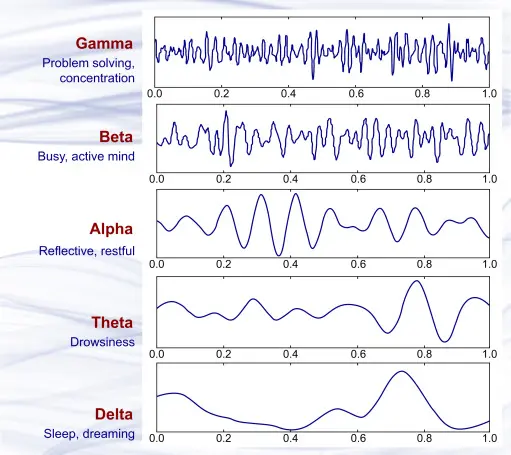
The Protocol: Block 90 to 120-minute periods of zero-distraction time. Phone in another room, notifications disabled, and a single task on the desk. This allows your brain to transition from the scattered, high-frequency “Beta” state into the highly focused “Alpha” state where actual problem-solving occurs.

2. Tactical Neurochemical Management Most professionals use caffeine as a blunt instrument to fight fatigue. We use it as a tactical tool to enhance focus.
The Protocol: Delay your first caffeine intake until 90–120 minutes after waking. This allows your body to naturally clear adenosine (the sleepiness molecule). When you finally introduce caffeine, you bypass the afternoon crash and sustain a smooth, focused output.
3. Deliberate Decompression (The Science of “Mindfulness”) The executive version of mindfulness is not about spiritual enlightenment; it is about autonomic control. When you are constantly “on,” your brain’s Default Mode Network (DMN) becomes overactive, leading to anxiety and rumination.
The Protocol: Implement 10 minutes of non-sleep deep rest (NSDR) or structured breathwork (like physiological sighing) between intense meetings. This acts as a cognitive palate cleanser, manually lowering your heart rate and resetting your focus for the next task.
The Cognitive Seesaw
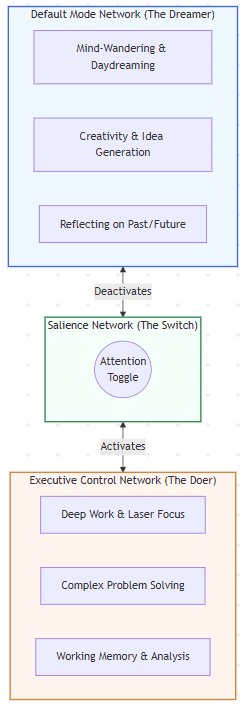
1. The Default Mode Network (The Dreamer)
What it is: This is your brain’s “resting state” or idling mode. It lights up when you are not focused on the outside world.
When it runs: While you are in the shower, going for a walk without a podcast, or staring out a window.
Why you need it: It is the engine of human creativity, empathy, and big-picture planning. The DMN connects seemingly unrelated dots to give you sudden “aha!” moments.
2. The Executive Control Network (The Doer)
What it is: The “task-positive” network. This is the heavy-lifting machinery of your brain.
When it runs: When you are studying, writing a complex report, solving a math equation, or actively listening in a meeting.
Why you need it: It provides goal-directed attention, filters out distractions, and manages your working memory.
3. The Salience Network (The Switch)
What it is: The monitor that decides which of the above networks needs to be active.
How it works: When you realize a deadline is approaching, the Salience Network flips the switch—it suppresses the DMN (stops you from daydreaming) and turns on the ECN (forces you to focus).
Strategic Overview: The Cognitive Seesaw
| Feature | The Dreamer (Default Mode Network) | The Doer (Executive Control Network) |
| Operational State | Passive / Resting | Active / Goal-Directed |
| Core Function | Creative synthesis & big-picture planning | Focused execution & problem-solving |
| Primary Output | "Aha!" moments, empathy, and innovation | Data processing, writing, and analysis |
| Executive Value | The Strategy: Connecting unrelated dots | The Tactics: Getting the deep work done |
| Common Trigger | Walking, showering, or staring out a window | Complex reports, math, or active listening |
| The Risk | Rumination, anxiety, or "analysis paralysis" | Cognitive fatigue, tunnel vision, and burnout |
The Executive Toggle: Why Your "Air Traffic Controller" is Overloaded
The Salience Network: Your Brain’s Switching Hub
The Salience Network (centered in the anterior insula and anterior cingulate cortex) constantly monitors both internal feelings and external demands. Its job is to decide: “What matters most right now?”
How the “Switch” Works:
Detection: The SN detects a high-priority stimulus (e.g., a complex email or a sudden creative insight).
The Toggle: It sends a signal to “quiet” the Dreamer (DMN) and “activate” the Doer (ECN), or vice versa.
The Failure Mode: High stress or chronic “multi-tasking” breaks this toggle. You end up in a “gray zone” where you are trying to work (ECN) but your mind is wandering to yesterday’s meeting (DMN). This is Cognitive Friction.
Executive Protocol: “Priming the Switch”
To help your readers optimize this transition, you can suggest these three “Salience Anchors”:
The 90-Minute Sprint (ECN Dominance): Set a timer. This tells the Salience Network that for the next 90 minutes, internal “daydreaming” is low priority.
The “Sensory Reset” (DMN Trigger): To stop overthinking and enter a creative state, engage the senses. A 5-minute walk without a phone forces the SN to disengage the ECN and let the DMN “play.”
The Transition Gap: Never jump from a high-stakes meeting (ECN) directly into a creative strategy session (DMN). You need a 2-minute “buffer” of deep breathing to allow the Salience Network to reset the see-saw.
The Key to Cognitive Performance
These two networks are generally anti-correlated, meaning you cannot easily run both at the same time. If you try to force high-level ECN focus for 10 hours straight, you will experience severe cognitive fatigue and burnout. Conversely, if you spend all day in the DMN, you will have great ideas but execute none of them.
Elite cognitive performance is not about maximizing the ECN; it is about cognitive flexibility—the ability to deliberately toggle between intense, focused execution (ECN) and intentional, unstructured rest (DMN) to let the brain process and recharge.
The Biological ROI
When you stop relying on sheer willpower and start managing your cognitive architecture, the returns are immediate:
Elimination of Brain Fog: By managing dopamine and reducing context switching, you end the day with mental clarity rather than severe cognitive fatigue.
Accelerated Execution: Deep work blocks allow you to produce higher-quality strategic output in a fraction of the time it takes a distracted peer.
Preservation of Executive Function: Protecting your attention span actively defends your brain’s prefrontal cortex from the long-term degradation caused by chronic stress and information overload.
🔬
Evidence & Citations
This article is based on scientific evidence and fact-checked by our editorial team. We prioritize peer-reviewed studies, clinical trials, and academic consensus.
- Newport, C. (2016). “Deep Work: Rules for Focused Success in a Distracted World.” Grand Central Publishing. (Reference: The “Attention Residue” Theory).
Leroy, S. (2009). “Why is it so hard to do my work? The challenge of attention residue when switching between work tasks.” Organization Science. View Study
- Fox, M. D., Snyder, A. Z., Vincent, J. L., Corbetta, M., Van Essen, D. C., & Raichle, M. E. (2005). The human brain is intrinsically organized into dynamic, anticorrelated functional networks. Proceedings of the National Academy of Sciences, 102(27), 9673–9678. View Study
- Brain Waves Patterns. (2024). ScienceDirect Topics. Elsevier B.V. Available at: https://www.sciencedirect.com/topics/agricultural-and-biological-sciences/brain-waves