
Why Your Calendar Might Be Your Best Nootropic: The Science of Social Connection
The Executive Summary
- The "Use It" Principle: Socializing is a complex cognitive task. It requires memory, attention, and emotional processing, acting as a "workout" for your brain.
- Cortisol Buffer: Meaningful connection lowers chronic stress hormones that otherwise fog the midlife brain and damage the hippocampus.
- Quality Over Quantity: You don't need a crowded party. Deep, one-on-one engagement provides the strongest neuroprotective benefits.
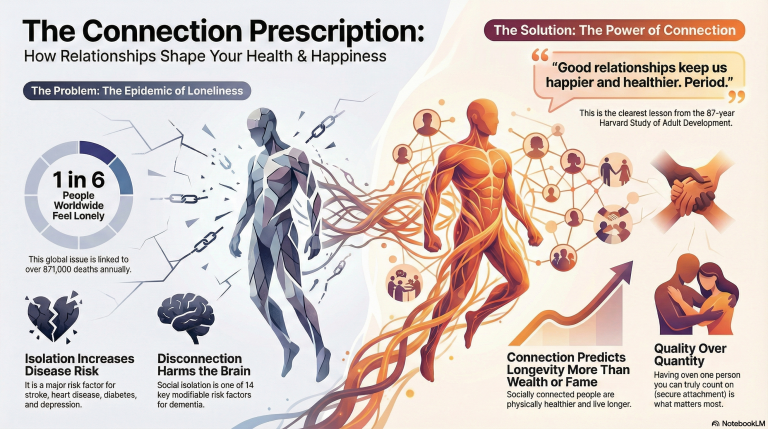
As professionals, we are excellent at optimizing. We track our sleep, we prioritize protein, and we schedule our workouts. Yet, in the busy transition of midlife—between career peaks, aging parents, and perhaps an emptying nest—we often view socializing as a "nice to have" rather than a biological necessity.
If you have been feeling that creeping sense of "brain fog" or finding it harder to recall names and words, the solution might not be another supplement. It might be a conversation. Today, let's explore Social Engagement as a critical pillar of cognitive resilience.
The Neuroscience of a Chat: It’s Not Just "Small Talk"
We tend to think of thinking as a solitary act—writing a report or solving a puzzle. But biologically, our brains evolved to navigate the complex web of a tribe.
When you engage in a meaningful conversation, your brain is performing a high-wire act. You are listening (Auditory Cortex), interpreting tone (Amygdala), remembering context (Hippocampus), and formulating a response (Prefrontal Cortex)—all in real-time. This is Cognitive Load Training.
For the midlife brain, which thrives on neuroplasticity (the ability to form new connections), isolation is essentially "bed rest" for your neurons. Engagement is the gym.
Your Internal "Stress Buffer" (Cortisol Regulation)
There is another layer to this. Midlife is often a high-cortisol season. Chronic stress is toxic to the brain, specifically shrinking the areas responsible for memory.
How connection protects the executive brain:
- Lowers Inflammation: Positive social interactions reduce levels of interleukin-6, an inflammatory marker linked to cognitive decline.
- Releases Oxytocin: This counters cortisol, helping to clear the "fog" caused by anxiety and stress.
- Builds Cognitive Reserve: A rich social life builds a "buffer" that allows the brain to cope better with aging or pathology.
What the Data Says (Realistically)
This isn't just a warm sentiment; it is hard science. The Lancet Commission on dementia prevention lists social isolation as one of the top modifiable risk factors for cognitive decline.
- The Risk Factor: Studies suggest loneliness can increase the risk of dementia by up to 50%—comparable to the risk of smoking.
- The Protective Effect: Maintaining a social network in your 50s and 60s correlates with better memory scores and slower rates of cognitive aging over a 10-year period.
Safety & Nuance: Introverts, Take Heart
A crucial distinction: Social engagement is not the same as social exhaustion.
For many of us, energy is precious. You do not need to fill your calendar with cocktail parties to get these benefits. In fact, research indicates that quality outperforms quantity. A one-hour coffee with a close friend where you feel understood provides far more neuroprotection than three hours of superficial networking.
If you are an introvert, protect your energy. Aim for "low dose, high depth" interactions.
The Bottom Line
As we navigate the second half of life, our definition of "health" must expand beyond just diet and exercise. Your calendar is a tool for brain health. Prioritize that lunch date, make that phone call, or join that community group. Your brain will thank you for the workout.
References
- Livingston, G., et al. (2020). "Dementia prevention, intervention, and care: 2020 report of the Lancet Commission." The Lancet.
- Waldinger, R. J., & Schulz, M. S. (2016). "The Harvard Study of Adult Development." Psychiatry.
- Cacioppo, J. T., & Cacioppo, S. (2014). "Social relationships and health: The toxic effects of perceived social isolation." Social and Personality Psychology Compass.